Geology and Minerals
Ionia Volcano
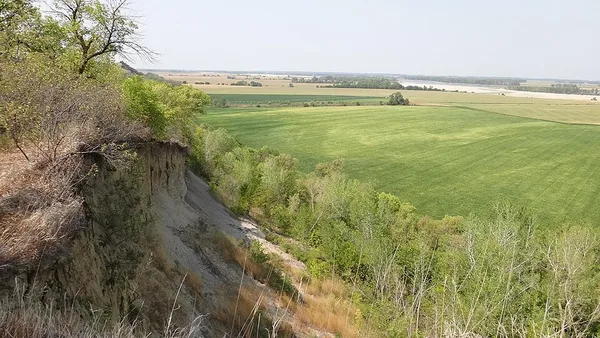
The Ionia Volcano (also referred to as Burnt Bluff or Volcano Hill) is a heat-producing bluff located east of Newcastle, Nebraska, although it has commonly been mistaken for an active volcano. The site was considered sacred by the Ponca and Arapaho Native American Tribes, and was documented by William Clark on the Lewis and Clark Expedition. The site was active throughout the 1800s until, in 1878, flooding by the Missouri River collapsed a large portion of the bluff and resulted in the abandonment of the nearby town of Ionia, its namesake. Erosion and subsequent flooding has since collapsed the rest of the bluff. The Ionia Volcano has "erupted" twice, once in 1879 and again in 1901, with the latter eruption preceding a period of dormancy. The Ionia Volcano was sporadically active throughout the 1900s but this was largely confined to smoke and steam output. The heat generated by the bluff results from iron sulfide oxidation in carbonaceous shale when it is exposed to moisture and oxygen due to erosion. Modern analysis has called into question if the bluff was witnessed by the Lewis and Clark Expedition or if another burning bluff in Maskell, Nebraska was observed. The site is classified as a High Potential Historic Site by the United States National Park Service.
Also on this shelf
Hallucigenia.
Eclogitization.
See also
Uncatalogued shelfText from Wikipedia; plate via Wikimedia Commons. Text CC BY-SA 4.0; plate freely licensed (see Commons). Source record. Images and catalogue data are reproduced from open-access collections.