Geology and Minerals
Lava
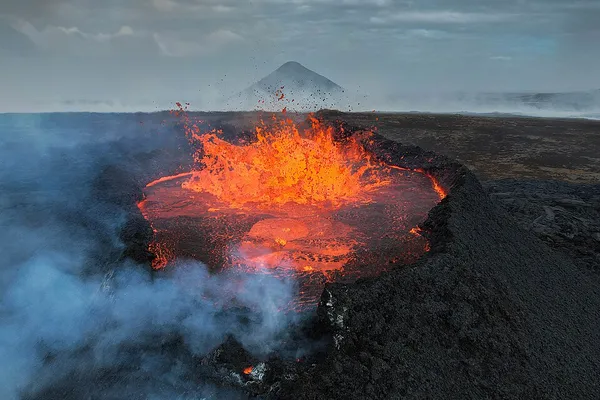
Lava is magma that has been expelled from the interior of a terrestrial planet (such as Earth) or a moon onto its surface. Lava may be erupted at a volcano or through a fracture in the crust, on land or underwater, usually at temperatures from 800 to 1,200 °C (1,470 to 2,190 °F). Lava may be erupted directly onto the land surface or onto the sea floor or it may be ejected into the atmosphere before falling back down. The solid volcanic rock resulting from subsequent cooling of the molten material is often also called lava. A lava flow is an outpouring of lava during an effusive eruption. (An explosive eruption, by contrast, produces a mixture of volcanic ash and other fragments called tephra, not lava flows.) The viscosity of most molten lava is about that of ketchup, roughly 10,000 to 100,000 times that of water (the latter two substances measured at 25 °C (77 °F) and 1 atm). Even so, lava can flow great distances before cooling causes it to solidify, because lava exposed to air quickly develops a solid crust that insulates the remaining liquid lava, helping to keep it hot and inviscid enough to continue flowing.
Also on this shelf
Geology of Kansas.
Cañadón Asfalto Formation.
See also
Uncatalogued shelfText from Wikipedia; plate via Wikimedia Commons. Text CC BY-SA 4.0; plate freely licensed (see Commons). Source record. Images and catalogue data are reproduced from open-access collections.