Geology and Minerals
Appalachian Mountains
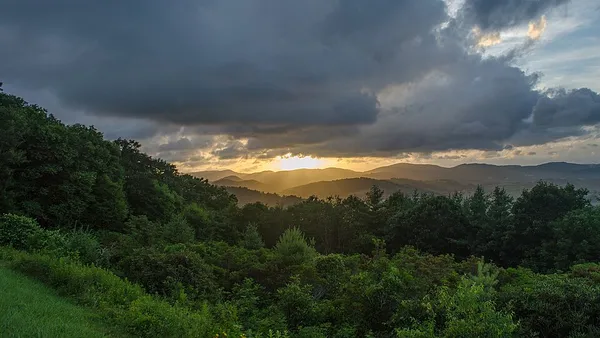
The Appalachian Mountains are a vast mountain range situated in eastern North America, extending roughly 2,050 miles (3,300 km) from central Alabama to Newfoundland along a generally southwest–northeast axis. Alongside the Appalachian Plateau province—with which they are not entirely synonymous—the mountains form a wider system comprising the region's backbone. The range's highest peak is 6,684-foot (2,037 m) Mount Mitchell in the Black Mountains subrange of North Carolina, which themselves are part of the larger Blue Ridge Mountains. Saint Pierre and Miquelon, an overseas collectivity of France, is part of the range, meaning it technically spans portions of three countries. It is geologically related to the Scottish Highlands, Atlas Mountains, Scandinavian Mountains, and Ouachitas, as these ranges all originally belonged to the sprawling Central Pangean Mountains before plate tectonics tore them apart. The geologic processes that led to the formation of the Appalachian Mountains started around 1.1 billion years ago with the creation of supercontinent Rodinia, and many Precambrian rocks and minerals created via this process remain visible today in the range's outcrops. The modern Appalachians and their relatives themselves were created by a series of three distinct orogenies beginning approximately 480 million years ago, making them one of the oldest surviving mountain ranges in the world. The young Appalachians reached elevations similar to today's Alps and Rockies—both of which are significantly younger mountain ranges—before 240 million years of natural erosion by water, wind, ice, and gravity gradually morphed them into the lower, rugged peaks typically seen today. Considering their extensive length, the Appalachians contain a diverse selection of biomes ranging from the temperate broadleaf and mixed Appalachian-Blue Ridge forest in the south to the boreal Eastern Canadian forest in the north. Conifers like red spruce and balsam fir dominate the north and high elevations, while deciduous trees like sugar maple and beech are more prevalent further south and oak-chestnut forests reign between. The climate ranges from humid subtropical to subarctic, with a few peaks in the Presidential Range of New Hampshire's White Mountains having a true tundra climate; many locations are also oceanic or humid continental.
Also on this shelf
Dunedin Volcano.
Garrett County, Maryland.
See also
- ▸Eodicynodon Assemblage Zone
- ▸History of the United States government
- ▸Cascade Volcanic Arc calderas
Text from Wikipedia; plate via Wikimedia Commons. Text CC BY-SA 4.0; plate freely licensed (see Commons). Source record. Images and catalogue data are reproduced from open-access collections.