Geology and Minerals
Geology of Venus
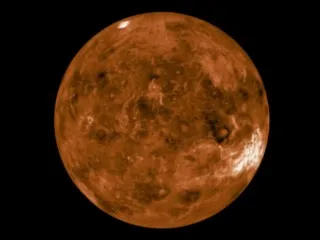
The geology of Venus is the scientific study of the surface, crust, and interior of the planet Venus. Within the Solar System, it is the one nearest to Earth and most like it in terms of mass, but has no intrinsic magnetic field or recognizable plate tectonics. About 75% of the surface is composed of bare rock, predominantly volcanic bedrock, some with thin and patchy layers of regolith. This is in marked contrast with Earth, the Moon, and Mars. Some impact craters are present, but the vast majority of the surface is uncratered. This is due in part to the thickness of the Venusian atmosphere disrupting small impactors before they strike the ground, but the paucity of large craters may be due to volcanic re-surfacing, possibly of a catastrophic nature. Volcanism appears to be the dominant agent of geological change on Venus. Some of the volcanic landforms appear to be unique to the planet, such as arachnoids and pancake domes. There are shield and composite volcanoes similar to those found on Earth, although these volcanoes are significantly shorter than those found on Earth or Mars. Given that Venus has approximately the same size, density, and composition as Earth, it is plausible that volcanism may be continuing on the planet today, as demonstrated by recent studies. Most of the Venusian surface is relatively flat; it is divided into three general topographic units: lowlands, highlands, and plains. In the early days of radar observation the highlands drew comparisons to the continents of Earth, but modern research has shown that this is superficial and the absence of plate tectonics makes this comparison misleading. Tectonic features are present to a limited extent, including linear "deformation belts" composed of folds and faults. These may be caused by mantle convection. Many of the tectonic features such as tesserae (large regions of highly deformed terrain, folded and fractured in two or three dimensions), and arachnoids (those features resembling a spider's web) are associated with volcanism. Eolian landforms are not widespread on the planet's surface, but there is considerable evidence the planet's atmosphere causes the chemical weathering of rock, especially at high elevations. The planet is remarkably dry, with only a chemical trace of water vapor (20 ppm) in the Venusian atmosphere.
Also on this shelf
Extraterrestrial liquid water.
Dolomite (rock).
See also
Uncatalogued shelfText from Wikipedia; plate via Wikimedia Commons. Text CC BY-SA 4.0; plate freely licensed (see Commons). Source record. Images and catalogue data are reproduced from open-access collections.