Geology and Minerals
Carbon capture and storage
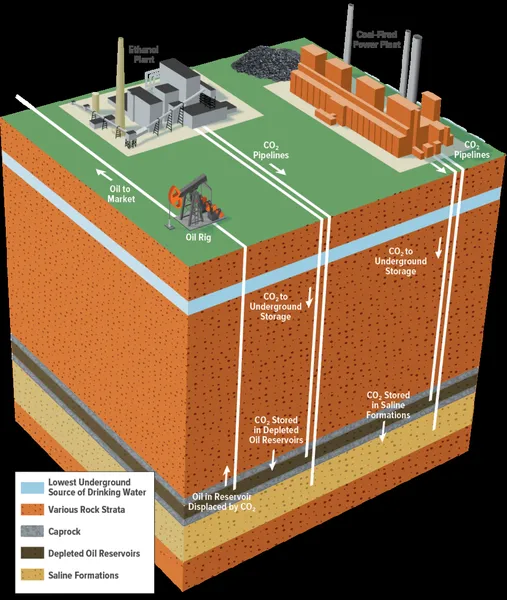
Carbon capture and storage (CCS) is a process by which carbon dioxide (CO2) from industrial installations or natural sources is separated before it is released into the atmosphere, then transported to a long-term storage location. The CO2 is captured from a large point source, such as a natural gas processing plant and is typically stored in a deep geological formation. Around 80% of the CO2 captured annually is used for enhanced oil recovery (EOR), a process by which CO2 is injected into partially depleted oil reservoirs in order to extract more oil and then is largely left underground. Since EOR utilizes the CO2 in addition to storing it, CCS is also known as carbon capture, utilization, and storage (CCUS). Oil and gas companies first used the processes involved in CCS in the mid‑20th century. Early CCS technologies were mainly used to purify natural gas and increase oil production. From the 1980s, and especially in the 2000s, CCS began to be discussed as a strategy to reduce greenhouse gas emissions. A 2022 review found that around 70% of announced CCS projects had not materialized, with a failure rate above 98% in the electricity sector. As of 2024, CCS was in operation at 44 plants worldwide, collectively capturing about one‑thousandth of global carbon dioxide emissions, and about 90% of CCS operations involved the oil and gas industry. Plants with CCS require more energy to operate, so they typically burn additional fossil fuels and increase the pollution associated with extracting and transporting fuel. CCS could have a critical but limited role in reducing greenhouse gas emissions. However, other emission-reduction options such as solar and wind energy, electrification, and public transit are less expensive than CCS and are much more effective at reducing air pollution. Given its cost and limitations, CCS is envisioned to be most useful in specific niches. These niches include heavy industry and plant retrofits. In the context of deep and sustained cuts in natural gas consumption, CCS can reduce emissions from natural gas processing. In electricity generation and hydrogen production, CCS is envisioned to complement a broader shift to renewable energy. CCS is a component of bioenergy with carbon capture and storage, which can under some conditions remove carbon from the atmosphere.
Also on this shelf
Anak Krakatoa.
Andes.
See also
Uncatalogued shelfText from Wikipedia; plate via Wikimedia Commons. Text CC BY-SA 4.0; plate freely licensed (see Commons). Source record. Images and catalogue data are reproduced from open-access collections.