Geology and Minerals
Agrio Formation
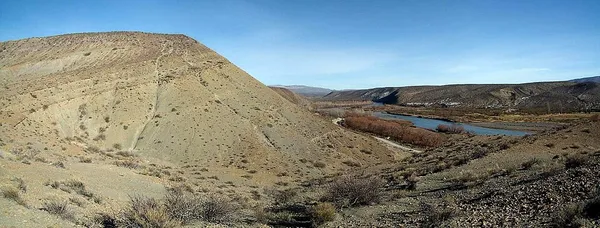
The Agrio Formation is an Early Cretaceous geologic formation that is up to 1,500 metres (4,900 ft) thick and is located in the southern Mendoza Province and northern-central Neuquén Province, in the Neuquén Basin of northwestern Patagonia, Argentina. This formation is the youngest one of the Mendoza Group, overlying the Mulichinco and Bajada Colorada Formations and overlain by the Huitrín and La Amarga Formations. It is dated to the Late Valanginian to Early Hauterivian, Late Valanginian to Early Barremian, or Hauterivian to earliest Aptian. The Agrio Formation is considered the third most important source rock in the hydrocarbon-rich Neuquén Basin, after the Vaca Muerta Formation and Los Molles Formation. Similarly to these older units, it is potentially a source of shale gas. This formation has provided fossils of ichthyosaurs, ammonites, gastropods, bivalves, decapods, echinoderm, corals and fish. The newly described species of fish, Tranawuen agrioensis, the ammonite Holcoptychites agrioensis, and the bivalve Pholadomya agrioensis have been named after the formation.
Also on this shelf
Herkimer (village), New York.
Bean Station, Tennessee.
See also
Uncatalogued shelfText from Wikipedia; plate via Wikimedia Commons. Text CC BY-SA 4.0; plate freely licensed (see Commons). Source record. Images and catalogue data are reproduced from open-access collections.