Geology and Minerals
Calthemite
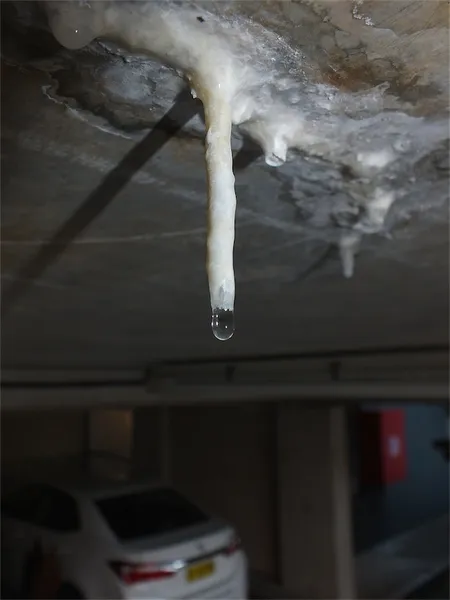
Calthemite is a secondary deposit, derived from concrete, lime, mortar or other calcareous material outside the cave environment. Calthemites grow on or under man-made structures and mimic the shapes and forms of cave speleothems, such as stalactites, stalagmites, flowstone etc. Calthemite is derived from the Latin calx (genitive calcis) "lime" + Latin < Greek théma, "deposit" meaning ‘something laid down’, (also Mediaeval Latin thema, "deposit") and the Latin –ita < Greek -itēs – used as a suffix indicating a mineral or rock. The term "speleothem", due to its definition (spēlaion "cave" + théma "deposit" in ancient Greek) can only be used to describe secondary deposits in caves and does not include secondary deposits outside the cave environment.
Also on this shelf
Geology of East Sussex.
Bears Ears National Monument.
See also
Uncatalogued shelfText from Wikipedia; plate via Wikimedia Commons. Text CC BY-SA 4.0; plate freely licensed (see Commons). Source record. Images and catalogue data are reproduced from open-access collections.