Geology and Minerals
Autunite
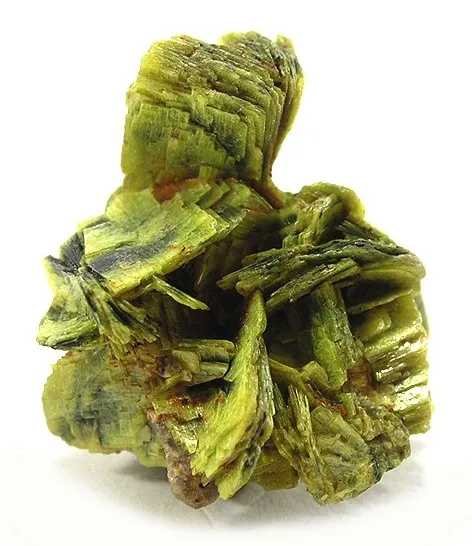
Autunite (hydrated calcium uranyl phosphate), with formula Ca(UO2)2(PO4)2·10–12H2O, is a yellow-greenish fluorescent phosphate mineral with a hardness of 2–2+1⁄2. Autunite crystallizes in the orthorhombic system and often occurs as tabular square crystals, commonly in small crusts or in fan-like masses. Due to the moderate uranium content of 48.27% it is radioactive and also used as uranium ore. Autunite fluoresces bright green to lime green under UV light. The mineral is also called calco-uranite, but this name is rarely used and effectively outdated. Autunite was discovered in 1852 near Autun, France, which is also autunite's namesake. It occurs as an oxidation product of uranium minerals in granite pegmatites and hydrothermal deposits. Associate minerals include metaautunite, torbernite, phosphuranylite, saleeite, uranophane and sabugalite.
Also on this shelf
Duluth Complex.
Fayetteville, Arkansas.
See also
Uncatalogued shelfText from Wikipedia; plate via Wikimedia Commons. Text CC BY-SA 4.0; plate freely licensed (see Commons). Source record. Images and catalogue data are reproduced from open-access collections.