Geology and Minerals
Geology of Europe
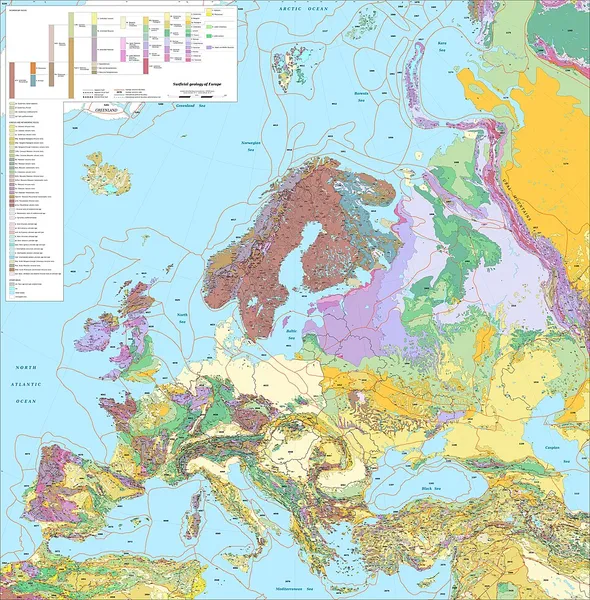
The geology of Europe is varied and complex, and gives rise to the wide variety of landscapes found across the continent, from the Scottish Highlands to the rolling plains of Hungary. Europe's most significant feature is the dichotomy between highland and mountainous Southern Europe and a vast, partially underwater, northern plain ranging from England in the west to the Ural Mountains in the east. These two halves are separated by the Pyrenees and the Alps-Carpathians mountain chain. The northern plains are delimited in the west by the Scandinavian Mountains and the mountainous parts of the British Isles. The southern mountainous region is bounded by the Mediterranean Sea and the Black Sea. Major shallow water bodies submerging parts of the northern plains are the Celtic Sea, the North Sea, the Baltic Sea and the Barents Sea. Weathering mantles made up of saprolite are common in Europe. Saprolite composition varies from kaolinitic and ferrallitic to grus. The first were formed in the Mesozoic and early Cenozoic while the latter in the late Cenozoic. Stripping of weathered rock has produced depressions occupied by numerous lakes in Finland and Sweden.
Also on this shelf
Eldorado Canyon State Park.
Brig Bay.
See also
Uncatalogued shelfText from Wikipedia; plate via Wikimedia Commons. Text CC BY-SA 4.0; plate freely licensed (see Commons). Source record. Images and catalogue data are reproduced from open-access collections.