Geology and Minerals
Edmontosaurus mummy AMNH 5060
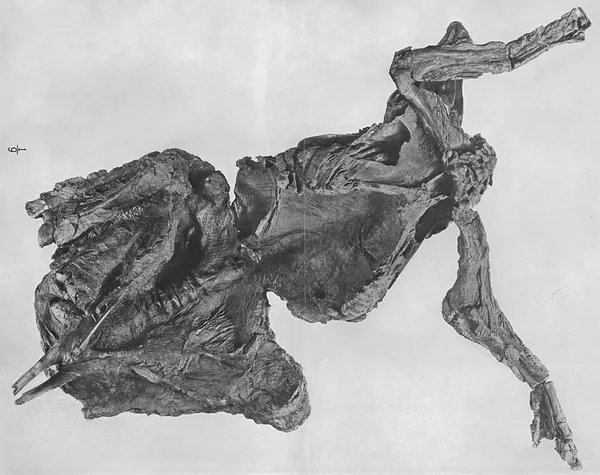
The Edmontosaurus mummy AMNH 5060, nicknamed the AMNH mummy, is an exceptionally well-preserved fossil of a dinosaur in the collection of the American Museum of Natural History (AMNH). Discovered in 1908 in the United States near Lusk, Wyoming, it was the first dinosaur specimen to be found encased in skin impressions. It is ascribed to the species Edmontosaurus annectens (originally known as Trachodon annectens), a hadrosaurid ("duck-billed dinosaur"). The mummy was found and excavated by fossil hunter Charles Hazelius Sternberg and his three sons in the Lance Formation. Although Sternberg was working under contract to the Natural History Museum, London, Henry Fairfield Osborn of the AMNH managed to secure the mummy. Osborn described the fossil in detail in 1912, coining the name dinosaur mummy for it—several dinosaur mummies of similar preservation have been discovered since then. This specimen has considerably influenced the scientific conception of hadrosaurids. Skin impressions found in between the fingers were initially interpreted as webbing, bolstering the now-rejected perception of hadrosaurids as aquatic animals. Today, the mummy is considered one of the most important fossils of the AMNH. The mummy was discovered lying on its back, its neck twisted backwards and its forelimbs outstretched. The skeleton is complete save the tail, hind feet, and the hind portion of the pelvis. All bones are preserved unflattened and still connected to each other. Almost two-thirds of the skin is preserved. Delicate for the size of the animal, the skin includes two different types of non-overlapping scales that were between 1 and 5 mm (0.039 and 0.197 in) in diameter. A flexible frill of skin is preserved in the neck area. In contrast with other similar dinosaur mummies, the skin of AMNH 5060 was tightly attached to the bones and partially drawn into the body interior, indicating that the carcass dried out before burial. The specimen would thus constitute the fossil of a natural mummy. After dehydration, the mummy likely would have been rapidly buried by a meandering river and rapidly filled with sediment. After burial, a thin clay layer would have formed on the skin, preserving the external shape of the latter.
Also on this shelf
Furnas.
Interstate 24 in Kentucky.
See also
Uncatalogued shelfText from Wikipedia; plate via Wikimedia Commons. Text CC BY-SA 4.0; plate freely licensed (see Commons). Source record. Images and catalogue data are reproduced from open-access collections.