Geology and Minerals
Black Hills
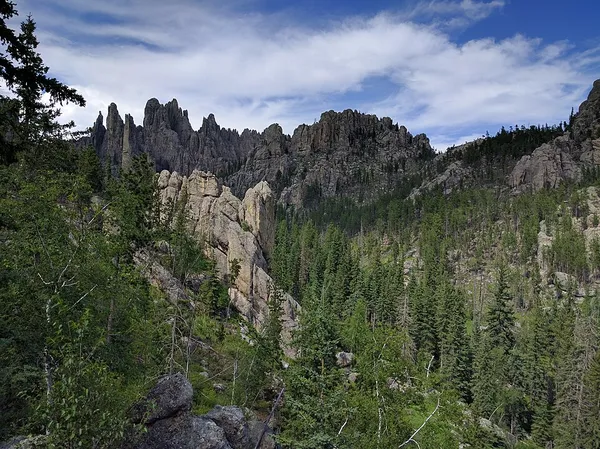
The Black Hills are an outlying subrange of the greater Rocky Mountain system rising from the Great Plains of North America in western South Dakota and eastern Wyoming, United States. Black Elk Peak, which rises to 7,242 feet (2,207 m), is the range's highest summit. The name of the range in Lakota is Pahá Sápa. It encompasses the Black Hills National Forest. It formed as a result of an upwarping of ancient rock, after which the removal of the higher portions of the mountain mass by stream erosion produced the present-day topography. The Black Hills are part of the North American Cordillera, specifically a range within the Rocky Mountain Front of Wyoming, South Dakota, and Montana. The mountains are so called because of their dark appearance from a distance, as they are covered in evergreen trees. American Indian tribes have a long history in the Black Hills and consider it a sacred site. After conquering the Cheyenne in 1776, the Lakota took the territory of the Black Hills, which became central to their culture. In 1868, the federal US government signed the Fort Laramie Treaty of 1868, establishing the Great Sioux Reservation west of the Missouri River, and exempting the Black Hills from all non-indigenous settlement “forever”; however, when American settlers discovered gold here as a result of George Armstrong Custer's Black Hills Expedition in 1874, a gold rush swept in miners. The US government conquered the Black Hills and forcibly relocated the Lakota, following the Great Sioux War of 1876, to five smaller reservations in western South Dakota, selling off 9 million acres (36,000 km2) of their former land. Unlike most of South Dakota, the Black Hills were settled primarily by European Americans from population centers to the west and south of the region, as miners flocked there from earlier gold boom locations in Colorado and Montana. As the economy of the Black Hills has shifted away from natural resources (mining and timber) since the late 20th century, the hospitality and tourism industries have grown to take its place.
Also on this shelf
Boxwork.
Dunite.
See also
Uncatalogued shelfText from Wikipedia; plate via Wikimedia Commons. Text CC BY-SA 4.0; plate freely licensed (see Commons). Source record. Images and catalogue data are reproduced from open-access collections.