Geology and Minerals
Big Al (dinosaur)
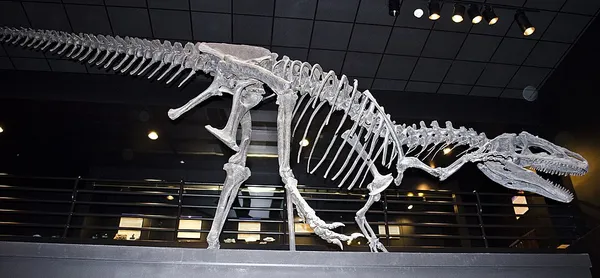
Big Al, officially designated as MOR 693, is a nearly complete fossil Allosaurus skeleton found near Shell, Wyoming in rocks of the Morrison Formation. The skeleton is about 95% complete and is one of the most complete Allosaurus specimen known; it was the most complete dinosaur specimen found in Wyoming at the time of discovery. Big Al shows 19 pathologies (signs of injury or disease) across the skeleton, most of them traumatic, with some showing evidence of healing. One of the most serious injuries is a large swelling in the first toe bone of the central, weight-bearing digit of the right foot; this bone shows signs of infection and might have caused a limp. Big Al was discovered in 1991 by a Swiss commercial fossil collecting team led by Kirby Siber. The team began field work in the area in 1990, when they re-opened the historical Howe Quarry. After the latter was depleted, the team encountered an additional locality 300 m (980 ft) to the north, where they excavated Big Al the following summer. While Howe Quarry was on private land, for which the team had permission, the Big Al quarry was on public land, as was subsequently determined by officials from the Bureau of Land Management. The excavation was therefore taken over by the Museum of the Rockies (MOR), where it is stored today. Big Al sparked broad public interest, culminating in the 2000 BBC documentary The Ballad of Big Al.
Also on this shelf
Crystal Cave (Sequoia National Park).
Gore Mountain Garnet.
See also
Uncatalogued shelfText from Wikipedia; plate via Wikimedia Commons. Text CC BY-SA 4.0; plate freely licensed (see Commons). Source record. Images and catalogue data are reproduced from open-access collections.