Geology and Minerals
Geography of Japan
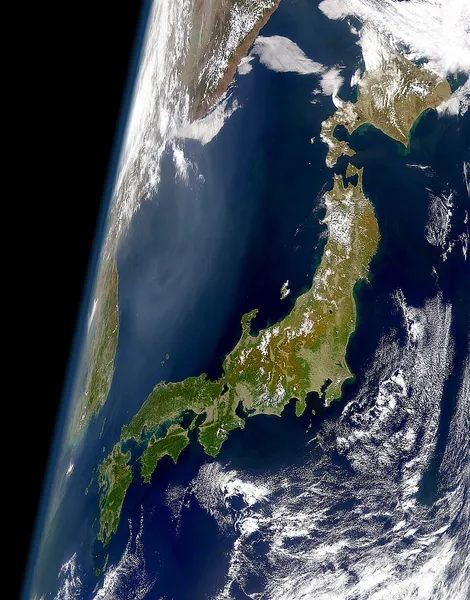
Japan is an archipelagic country comprising a stratovolcanic archipelago over 3,000 km (1,900 mi) along the Pacific coast of East Asia. It consists of 14,125 islands. The five main islands are Hokkaido, Honshu, Kyushu, Shikoku, and Okinawa. The other 14,120 islands are classified as "remote islands" by the Japanese government. The Ryukyu Islands and Nanpō Islands are south and east of the main islands. The territory covers 377,973.89 km2 (145,936.53 sq mi). It is the fourth-largest island country in the world and the largest island country in East Asia. The country has the 6th longest coastline at 29,751 km (18,486 mi) and the 8th largest Exclusive Economic Zone of 4,470,000 km2 (1,730,000 sq mi) in the world. The terrain is mostly rugged and mountainous, with 66% forest. The population is clustered in urban areas along the coast, plains, and valleys. Japan is located in the northwestern Ring of Fire on multiple tectonic plates. East of the Japanese archipelago are three oceanic trenches. The Japan Trench is created as the oceanic Pacific Plate subducts beneath the continental Okhotsk Plate. The continuous subduction process causes frequent earthquakes, tsunamis, and stratovolcanoes. The islands are also affected by typhoons. The subduction plates have pulled the Japanese archipelago eastward, created the Sea of Japan, and separated it from the Asian continent by back-arc spreading 15 million years ago. The climate varies from humid continental in the north to humid subtropical and tropical rainforests in the south. These differences in climate and landscape have allowed the development of a diverse flora and fauna, with some rare endemic species, especially in the Ogasawara Islands. Japan extends from 20° to 45° north latitude (Okinotorishima to Benten-jima) and from 122° to 153° east longitude (Yonaguni to Minami Torishima). Japan is surrounded by seas. To the north, the Sea of Okhotsk separates it from the Russian Far East; to the west, the Sea of Japan separates it from the Korean Peninsula; to the southwest, the East China Sea separates the Ryukyu Islands from China and Taiwan; to the east is the Pacific Ocean. The Japanese archipelago is over 3,000 km (1,900 mi) long in a north-to-southwardly direction from the Sea of Okhotsk to the Philippine Sea in the Pacific Ocean. It is narrow, and no point in Japan is more than 150 km (93 mi) from the sea.
Also on this shelf
Evaporite.
Mauna Kea.
See also
Uncatalogued shelfText from Wikipedia; plate via Wikimedia Commons. Text CC BY-SA 4.0; plate freely licensed (see Commons). Source record. Images and catalogue data are reproduced from open-access collections.