Geology and Minerals
Banded iron formation
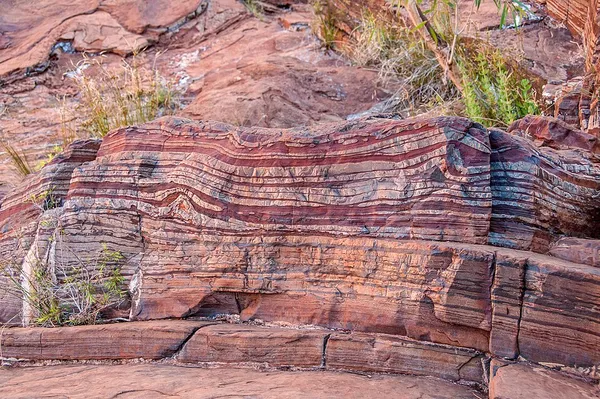
Banded iron formations (BIFs; also called banded ironstone formations) are distinctive units of sedimentary rock consisting of alternating layers of iron oxides and iron-poor chert. They can be up to several hundred meters in thickness and extend laterally for several hundred kilometers. Almost all of these formations are of Precambrian age and are theorized to record the oxygenation of the Earth's oceans. Some of the Earth's oldest rock formations, which formed about 3,700 million years ago (Ma), are associated with banded iron formations. Banded iron formations are theorized to have formed in sea water as the result of oxygen production by photosynthetic cyanobacteria. The oxygen combined with dissolved iron in Earth's oceans to form insoluble iron oxides, which precipitated out, forming a thin layer on the ocean floor. Each band is similar to a varve, resulting from cyclic variations in oxygen production. Banded iron formations were first discovered in northern Michigan in 1844. Banded iron formations account for more than 60% of global iron reserves and provide most of the iron ore presently mined. Most formations can be found in Australia, Brazil, Canada, India, Russia, South Africa, Ukraine, and the United States.
Also on this shelf
Geology of Dorset.
Geology of Ghana.
See also
Uncatalogued shelfText from Wikipedia; plate via Wikimedia Commons. Text CC BY-SA 4.0; plate freely licensed (see Commons). Source record. Images and catalogue data are reproduced from open-access collections.