Geology and Minerals
Cañadón Asfalto Formation
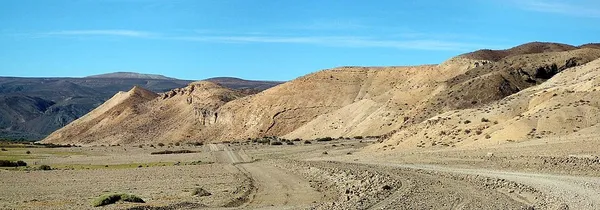
The Cañadón Asfalto Formation is a geological formation from the Lower Jurassic, with doubtful layers of Late Jurassic age previously referred to it. The Cañadón Asfalto Formation is located in the Cañadón Asfalto Basin, a rift basin in the Chubut Province of northwestern Patagonia, southern Argentina. The basin started forming in the earliest Jurassic. The formation is composed of fluvial-lacustrine deposits, typically sandstones and shales with a saline paleolake carbonate evaporitic sequence of limestone in its lowest Las Chacritas Member. Interbedded with these are volcanic tuffites. It is divided into two members, the Las Chacritas Member, and the overlying Puesto Almada member, but the latter has also been assigned to the overlying Cañadón Calcáreo Formation by other authors. The exact age of the formation has been controversial, with uranium-lead dating of the volcanic tuff beds having given various different ages. Recent work has suggested that the base of the formation was formed around 171 Ma, during the upper Aalenian, with the main age for the Lower Las Chacritas Member being around 168 Ma, during the Bajocian, Bathonian and Callovian, while the overlying Puesto Almada Member seems to be around 158 Ma, or Oxfordian in age. But that changed thanks to the discovery of zircons near the location of the discovery of Bagualia, allowing a precise dating of the Las Charcitas Member as Middle-Late Toarcian, 178-179 million years. And a more advanced dating constrained the age of the formation as Middle-Late Toarcian, contemporaneous to the Chon Aike volcanic activity, making it a local equivalent to Antarctica's Mawson Formation (Ferrar Volcanic Province) and the South African Drakensberg Group (Karoo Volcanic Province). This unit belongs to the Patagonia-Antarctic Peninsula sequence, along with the Marifil, Lonco Trapial & Garamilla Formation in Central-Northern Patagonia. They form part of the wider first-stage event (V1) of the Chon Aike Province, proving connection with both areas in the Early Jurassic, with the closest unit in South America being the Bahía Laura Volcanic Complex (Deseado Massif), the Quemado Complex (Austral Patagonia) & the Tobífera and Lemaire Formations (Fuegian Andes). Other Units include Bajo Pobre, Cañadón Huemules and Roca Blanca Formations in Argentina.
Also on this shelf
1991 Mount Unzen eruption.
Berkeley Pit.
See also
Uncatalogued shelfText from Wikipedia; plate via Wikimedia Commons. Text CC BY-SA 4.0; plate freely licensed (see Commons). Source record. Images and catalogue data are reproduced from open-access collections.