Geology and Minerals
Deformation (volcanology)
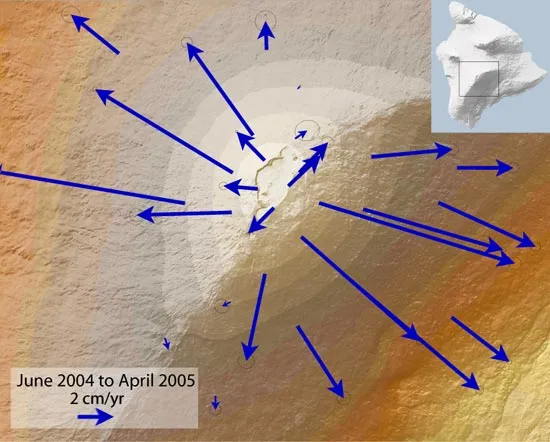
In volcanology, deformation refers to the change in the shape of a volcano or the surrounding landscape due to the movement of magma. This can be in the form of inflation, which is a response to pressurization, or deflation, which is a response to depressurization. Inflation is represented by swelling of the ground surface, a volcanic edifice, or a subsurface magma body. It can be caused by magma accumulation, exsolution of volatiles, geothermal processes, heating, and tectonic compression. Deflation is represented by shrinking of the ground surface, a volcanic edifice, or a subsurface magma body. It can be caused by magma withdrawal (related to intrusion or eruption), volatile escape, thermal contraction, phase changes during crystallization, and tectonic extension. Deformation is a key indicator of pre-eruptive unrest at many active volcanoes, but deformation signals must be used in combination with other eruption indicators for forecasting reliability.
Also on this shelf
Climate variability and change.
Bridport Sand Formation.
See also
Uncatalogued shelfText from Wikipedia; plate via Wikimedia Commons. Text CC BY-SA 4.0; plate freely licensed (see Commons). Source record. Images and catalogue data are reproduced from open-access collections.