Geology and Minerals
Geology of New Caledonia
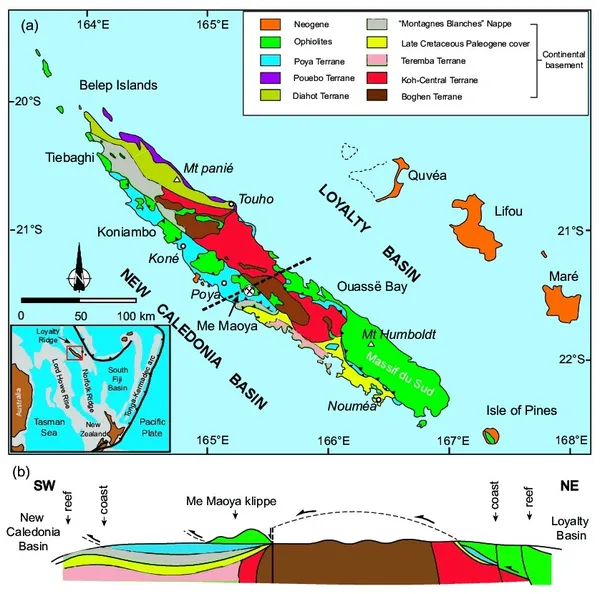
The geology of New Caledonia includes all major rock types (igneous, sedimentary, and metamorphic), which here range in age from ~290 million years old (Ma) to recent. Their formation is driven by alternate plate collisions and rifting. The mantle-derived Eocene Peridotite Nappe is the most significant and widespread unit (labelled as "Ophiolites" and coloured in bright green in Fig. 1). The igneous unit consists of ore-rich ultramafic rocks thrust onto the main island. Mining of valuable metals from this unit has been an economical pillar of New Caledonia for more than a century. New Caledonia is located on the Indo-Australian Plate and the largely submerged continent of Zealandia. After New Zealand, it is the second-largest subaerial landmass, and the northernmost part of this continent. As shown on the map, the landmass is elongated in a NW-SE orientation, which is similar to the distribution patterns of most of the geological units. Thrusting, exhumation and folding of some of the units have contributed to the rugged topography of the elongated main island, with Mont Panié and Mount Humboldt being the highest points (over 1,600 m).
Also on this shelf
Boron.
Grímsnes.
See also
Uncatalogued shelfText from Wikipedia; plate via Wikimedia Commons. Text CC BY-SA 4.0; plate freely licensed (see Commons). Source record. Images and catalogue data are reproduced from open-access collections.