Geology and Minerals
Agate
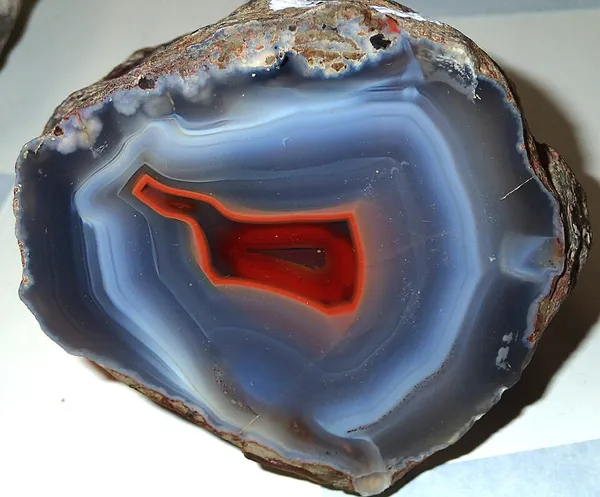
Agate ( AG-it) is a banded variety of fibrous chalcedony. Agate stones are characterized by alternating bands of different colored chalcedony and often contain some visible quartz crystals. They are common in nature and can be found globally in a large number of different varieties. Most agates are concentrically banded, while some have bands that form parallel lines. Certain varieties of chalcedony without bands are commonly called agate (e.g. moss agate, fire agate), but these are not true agates. Moreover, not every banded chalcedony is an agate (e.g. banded chert). Most agates form as nodules within volcanic rock, either as amygdules or thunder eggs. Agates also form in veins within any rock type and in silicified fossils. The processes that result in agate banding are not well understood; agate has never been made synthetically. Agate has been popular as a gemstone in jewelry for thousands of years, and today it is also popular as a collector's stone. Many duller agates sold commercially are artificially treated to enhance their color.
Also on this shelf
Cape Peninsula.
Ciechocinek Formation.
See also
Uncatalogued shelfText from Wikipedia; plate via Wikimedia Commons. Text CC BY-SA 4.0; plate freely licensed (see Commons). Source record. Images and catalogue data are reproduced from open-access collections.