Geology and Minerals
Baleen whale
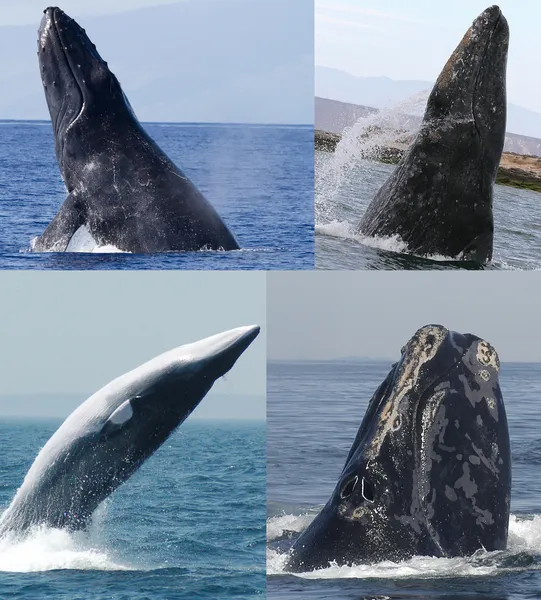
Baleen whales (), also known as whalebone whales, are marine mammals of the parvorder Mysticeti in the infraorder Cetacea (whales, dolphins and porpoises), which use baleen plates (or "whalebone") in their mouths to sieve plankton from the water. Mysticeti comprises the families Balaenidae (right and bowhead whales), Balaenopteridae (rorquals), Eschrichtiidae (the gray whale) and Cetotheriidae (the pygmy right whale). There are 16 species of baleen whales. While cetaceans were historically thought to have descended from mesonychians, molecular evidence instead supports them as a clade of even-toed ungulates (Artiodactyla). Baleen whales split from toothed whales (Odontoceti) around 34 million years ago. Baleen whales range in size from the 6 m (20 ft) and 3,000 kg (6,600 lb) pygmy right whale to the 31 m (102 ft) and 190 t (210 short tons) blue whale, the largest known animal to ever exist. They are sexually dimorphic. Baleen whales can have streamlined or large bodies, depending on the feeding behavior, and two limbs that are modified into flippers. The fin whale is the fastest baleen whale, recorded swimming at 10 m/s (36 km/h; 22 mph). Baleen whales use their baleen plates to filter out food from the water by either lunge-feeding or skim-feeding. Baleen whales have fused neck vertebrae, and are unable to turn their heads at all. Baleen whales have two blowholes. Some species are well adapted for diving to great depths. They have a layer of fat, or blubber, under the skin to keep warm in the cold water. Although baleen whales are widespread, most species prefer the colder waters of the Arctic and Antarctic. Gray whales are specialized for feeding on bottom-dwelling crustaceans. Rorquals are specialized at lunge-feeding, and have a streamlined body to reduce drag while accelerating. Right whales skim-feed, meaning they use their enlarged head to effectively take in a large amount of water and sieve the slow-moving prey. Males typically mate with more than one female (polygyny), although the degree of polygyny varies with the species. Male strategies for reproductive success vary between performing ritual displays (whale song) or lek mating. Calves are typically born in the winter and spring months and females bear all the responsibility for raising them.
Also on this shelf
Compact Reconnaissance Imaging Spectrometer for Mars.
Isluga.
See also
Uncatalogued shelfText from Wikipedia; plate via Wikimedia Commons. Text CC BY-SA 4.0; plate freely licensed (see Commons). Source record. Images and catalogue data are reproduced from open-access collections.