Geology and Minerals
Deep sea mining
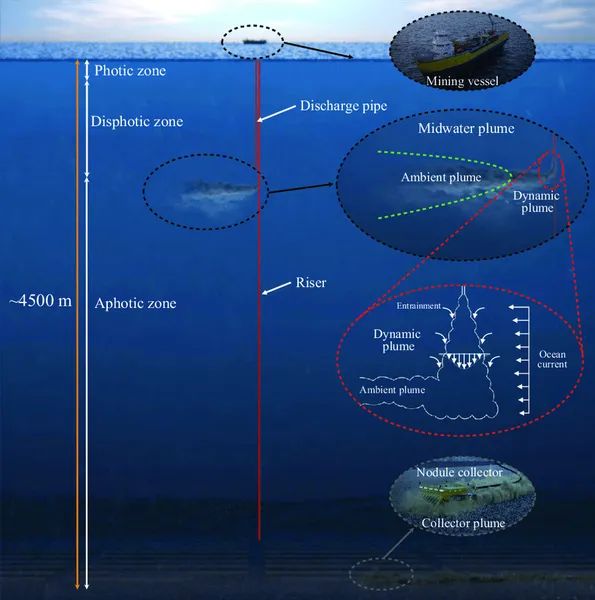
Deep sea mining is the extraction of minerals from the seabed of the deep sea. The main ores of commercial interest are polymetallic nodules, which are found at depths of 4–6 km (2.5–3.7 mi) primarily on the abyssal plain. The Clarion–Clipperton zone (CCZ) alone contains over 21 billion metric tons of these nodules, with minerals such as copper, nickel, cobalt and manganese making up roughly 30% of their weight. It is estimated that the global ocean floor holds more than 120 million tons of cobalt, five times the amount found in terrestrial reserves. Studies have shown that midwater mining techniques causing plumes can trigger bottom-up ecosystem impacts with severe consequences to marine life, extending beyond the initial mining area. As of July 2024, only exploratory licenses have been issued, with no commercial-scale deep sea mining operations yet. The International Seabed Authority (ISA) regulates all mineral-related activities in international waters and has granted 31 exploration licenses so far: 19 for polymetallic nodules, mostly in the CCZ; 7 for polymetallic sulphides in mid-ocean ridges; and 5 for cobalt-rich crusts in the Western Pacific Ocean. There is a push for deep sea mining to commence by 2025, when regulations by the ISA are expected to be completed. In April 2025, U.S. President Trump signed an Executive Order instructing the National Oceanic and Atmospheric Administration to expedite permits for companies to mine in both international and U.S. territorial waters, citing the Deep Seabed Hard Minerals Resource Act of 1980. Deep sea mining is being considered in the exclusive economic zone (EEZ) of countries, such as Norway, where in January 2024 the government announced its intention to allow companies to apply for exploration permits in 2025. In December 2024, Norway's plans to begin awarding exploration licenses were temporarily put on hold after the Socialist Left Party (SV) blocked the planned licensing round as part of negotiations over the government budget. In 2022, the Cook Islands Seabed Minerals Authority (SBMA) granted three exploration licenses for cobalt-rich polymetallic nodules within their EEZ. In 2025, it was announced that the Cook Islands had signed a deal with China focused on deep-sea mining.
Also on this shelf
Aravalli Range.
Geology of the United States.
See also
Uncatalogued shelfText from Wikipedia; plate via Wikimedia Commons. Text CC BY-SA 4.0; plate freely licensed (see Commons). Source record. Images and catalogue data are reproduced from open-access collections.