Geology and Minerals
Glacier
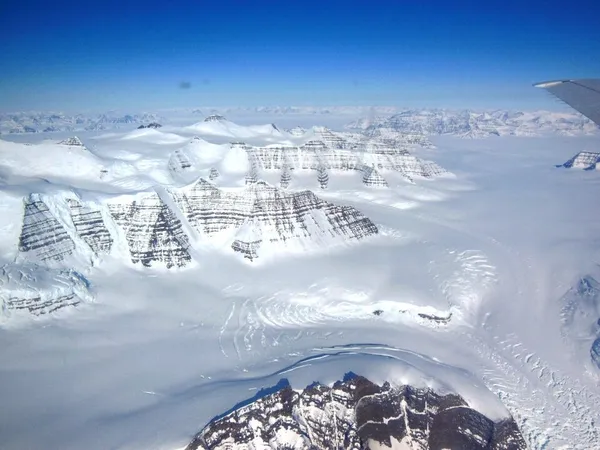
A glacier (US: ; UK: or ) is a persistent body of natural ice, a form of rock, that is constantly moving under its own weight. A glacier forms where the accumulation of snow exceeds its ablation over many years, often centuries. It slowly flows and deforms under stresses induced by gravity, undergoing both ductile and brittle deformation, and acquiring distinguishing surface features, such as crevasses and seracs. As a glacier moves, it abrades underlying rock and debris to create glacial landforms, such as cirques, moraines, and fjords. Although a glacier may flow into a body of water, and can include ice shelves and ice tongues, it originates only on land and is distinct from the much thinner sea ice and lake ice that form on the surface of freezing bodies of water. On Earth, 99% of glacial ice is contained within vast ice sheets (also known as "continental glaciers") in the polar regions, but glaciers may be found in mountain ranges on every continent other than the Australian mainland, including Oceania's high-latitude oceanic island countries such as New Zealand. Between latitudes 35°N and 35°S, glaciers occur only in the Himalayas, Andes, and a few high mountains in East Africa, Mexico, New Guinea and on Zard-Kuh in Iran. With more than 7,000 known glaciers, Pakistan has more glacial ice than any other country outside the polar regions. Glaciers cover about 10% of Earth's land surface. Continental glaciers cover nearly 13 million km2 (5 million sq mi) or about 98% of Antarctica's 13.2 million km2 (5.1 million sq mi), with an average thickness of ice 2,100 m (7,000 ft). Greenland and Patagonia also have huge expanses of continental glaciers. The volume of glaciers, not including the ice sheets of Antarctica and Greenland, has been estimated at 170,000 km3. Glacial ice is the largest reservoir of fresh water on Earth, holding with ice sheets about 69% of the world's freshwater. Many glaciers from temperate, alpine and seasonal polar climates store water as ice during the colder seasons and release it later in the form of meltwater as warmer summer temperatures cause the glacier to melt, creating a water source that is especially important for plants, animals and human uses when other sources may be scant.
Also on this shelf
Cement kiln.
Crater Lake National Park.
See also
Uncatalogued shelfText from Wikipedia; plate via Wikimedia Commons. Text CC BY-SA 4.0; plate freely licensed (see Commons). Source record. Images and catalogue data are reproduced from open-access collections.