Geology and Minerals
Ediacaran biota
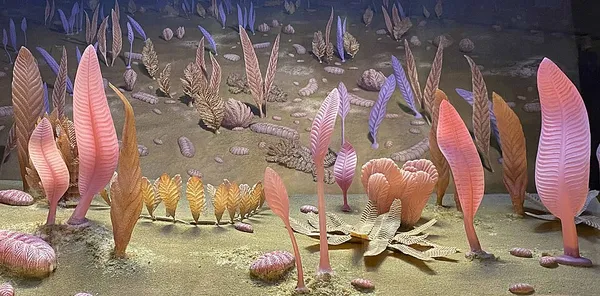
The Ediacaran biota ( EE-dee-ACK-ər-ən; formerly Vendian) is a group of large, biologically complex, mostly soft-bodied organisms, which lived during the Ediacaran Period (c. 635–538.8 Mya). These were unusual tube and frond-shaped, mostly sessile, organisms. Three distinct assemblages of these organisms have been discovered, preserved as trace fossils in Ediacaran sandstone. They represent the earliest known complex multicellular organisms. The Ediacaran biota may have undergone evolutionary radiation in a proposed event called the Avalon explosion, 575 million years ago. This was after the Earth had thawed from the Cryogenian period's extensive glaciation. This biota largely disappeared with the rapid increase in biodiversity known as the Cambrian explosion. Most of the currently existing body plans of animals first appeared in the fossil record of the Cambrian rather than the Ediacaran. For macroorganisms, the Cambrian biota appears to have almost completely replaced the organisms that dominated the Ediacaran fossil record, although relationships are still a matter of debate. The organisms of the Ediacaran Period first appeared around 600 million years ago and flourished until the cusp of the Cambrian 538.8 million years ago, when the characteristic communities of fossils vanished. A diverse Ediacaran community was discovered in 1995 in Sonora, Mexico, and is approximately 555 million years in age, roughly coeval with Ediacaran fossils of the Ediacara Hills in South Australia and the White Sea on the coast of Russia. While rare fossils that may represent survivors have been found as late as the Middle Cambrian (510–500 Mya), the earlier fossil communities disappear from the record at the end of the Ediacaran, leaving only curious fragments of once-thriving ecosystems. Multiple hypotheses exist to explain the disappearance of this biota, including preservation bias, a changing environment, the advent of predators and competition from other life-forms.
Also on this shelf
Geology of the Canary Islands.
Kurile Lake.
See also
Uncatalogued shelfText from Wikipedia; plate via Wikimedia Commons. Text CC BY-SA 4.0; plate freely licensed (see Commons). Source record. Images and catalogue data are reproduced from open-access collections.