Geology and Minerals
Blue Ridge Mountains
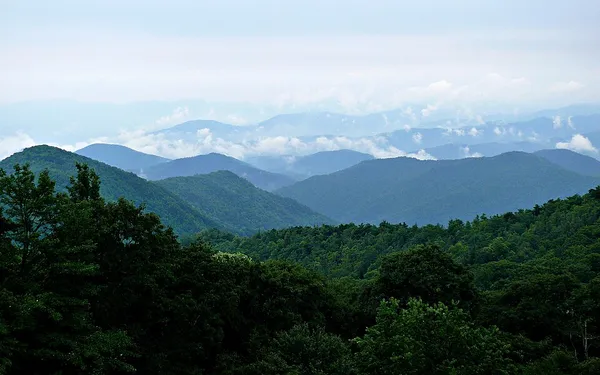
The Blue Ridge Mountains (Cherokee: ᏌᎪᏂᎨ ᏣᎴᎩ, Sagonige Tsalegi, "blue mountain ridge") are a physiographic province of the larger Appalachian Highlands range. The mountain range is located in the Eastern United States and extends 550 miles (885 km) southwest from southern Pennsylvania through Maryland, West Virginia, Virginia, North Carolina, South Carolina, Tennessee, and Georgia. The province consists of northern and southern physiographic regions, which divide near the Roanoke River gap. To the west of the Blue Ridge, between it and the bulk of the Appalachians, lies the Great Appalachian Valley, bordered on the west by the Ridge and Valley province of the Appalachian range. The Blue Ridge Mountains are known for having a bluish color when seen from a distance. Trees put the "blue" in Blue Ridge, from the isoprene released into the atmosphere. This contributes to the characteristic haze on the mountains and their perceived color. Within the Blue Ridge province are two major national parks: Shenandoah National Park in the northern section and Great Smoky Mountains National Park in the southern section. The Blue Ridge Parkway, a 469-mile (755 km) long scenic highway, connects the two parks and runs along the ridge crest-lines, as does the Appalachian Trail. Eight national forests include George Washington and Jefferson, Cherokee, Pisgah, Nantahala and Chattahoochee.
Also on this shelf
Economy of Morocco.
Frost weathering.
See also
Uncatalogued shelfText from Wikipedia; plate via Wikimedia Commons. Text CC BY-SA 4.0; plate freely licensed (see Commons). Source record. Images and catalogue data are reproduced from open-access collections.