Geology and Minerals
Glauconite
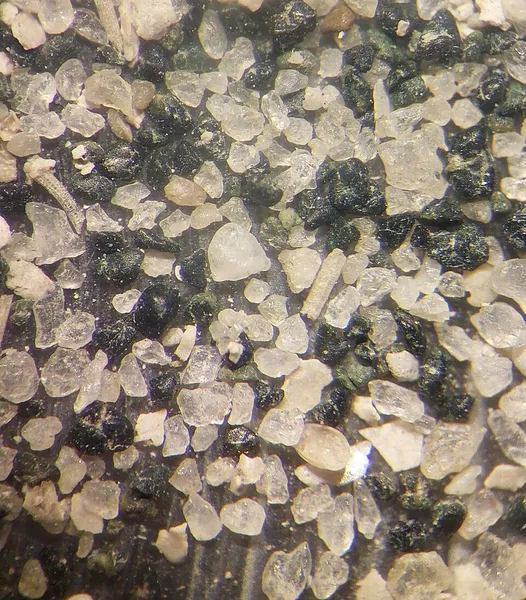
Glauconite is an iron potassium phyllosilicate (mica group) mineral of characteristic green color which is very friable and has very low weathering resistance. It crystallizes with a monoclinic geometry. Its name is derived from the Greek glaucos (γλαυκός) meaning 'bluish green', referring to the common blue-green color of the mineral; its sheen (mica glimmer) and blue-green color. Its color ranges from olive green, black green to bluish green, and yellowish on exposed surfaces due to oxidation. In the Mohs scale it has a hardness of 2, roughly the same as gypsum. The relative specific gravity range is 2.4–2.95. It is normally found as dark green rounded concretions with the dimensions of a sand grain. It can be confused with chlorite (also of green color) or with a clay mineral. Glauconite has the chemical formula (K,Na)(Fe,Al,Mg)2(Si,Al)4O10(OH)2. Glauconite particles are one of the main components of greensand, glauconitic siltstone and glauconitic sandstone. Glauconite has been called a marl in an old and broad sense of that word. Thus references to "greensand marl" sometimes refer specifically to glauconite. The Glauconitic Marl formation is named after it, and there is a glauconitic sandstone formation in the Mannville Group of Western Canada.
Also on this shelf
Dimension stone.
Boleite.
See also
Uncatalogued shelfText from Wikipedia; plate via Wikimedia Commons. Text CC BY-SA 4.0; plate freely licensed (see Commons). Source record. Images and catalogue data are reproduced from open-access collections.