Geology and Minerals
Confederate Gulch and Diamond City
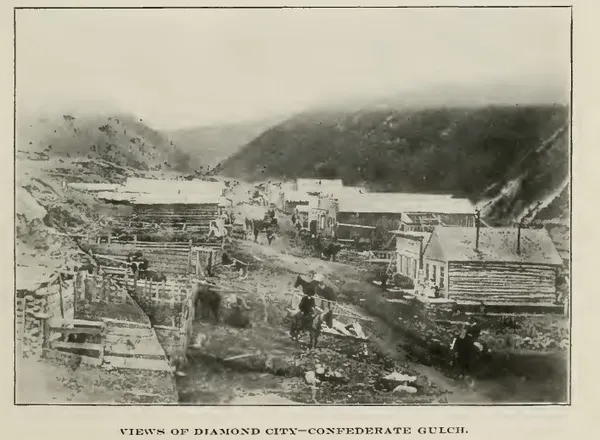
Confederate Gulch is a steeply incised gulch or valley on the west-facing slopes of the Big Belt Mountains in the U.S. state of Montana. Its small stream drains westward into Canyon Ferry Lake, on the upper Missouri River near present-day Townsend, Montana. In 1864, Confederate soldiers on parole during the American Civil War made a minor gold discovery in the gulch, but the discovery of the sensationally rich Montana Bar the following year—one of the richest placer strikes per acre ever made—led to other rich gold strikes up and down the gulch, and touched off a frantic boom period of placer gold mining in the area that extended through 1869. From 1866 to 1869, the gulch equaled or outstripped all other mining camps in the Montana Territory in gold production, producing an estimated $19–30 million worth of gold (in late 1860s dollars). For a time, Confederate Gulch was the largest community in Montana. In 1866, Montana had a total population of 28,000, and of these, about 10,000 (35%) were working in Confederate Gulch. The main boomtown serving the miners at Confederate Gulch was Diamond City (46°35′50″N 111°25′26″W). During its heyday, Diamond City was the county seat of Montana's Meagher County, though today the area is part of Broadwater County. While gold production was at its height, Diamond City roared along both night and day. In their frantic efforts to get at more gold, the miners built ditches and flumes that extended for miles, and employed high pressure hydraulic mining methods which washed down whole hillsides and ate up the gulch floor. The hydraulic mining process left huge spoil banks in the gulch and eventually consumed the original site of Diamond City, which had to be moved to a new location. By 1870, the gold supply at Confederate Gulch had been exhausted, the boom was over and the residents of Diamond City simply picked up and left. In 1870, there were only 255 people remaining, and a year later only about 60. Today hardly a trace remains of Diamond City or the other gulch communities. An unimproved road still winds up the gulch from the Missouri River valley and crosses the top of the Big Belts on its way down to the Smith River valley.
Also on this shelf
Apatite.
1669 eruption of Mount Etna.
See also
Uncatalogued shelfText from Wikipedia; plate via Wikimedia Commons. Text CC BY-SA 4.0; plate freely licensed (see Commons). Source record. Images and catalogue data are reproduced from open-access collections.