Geology and Minerals
Great Oxidation Event
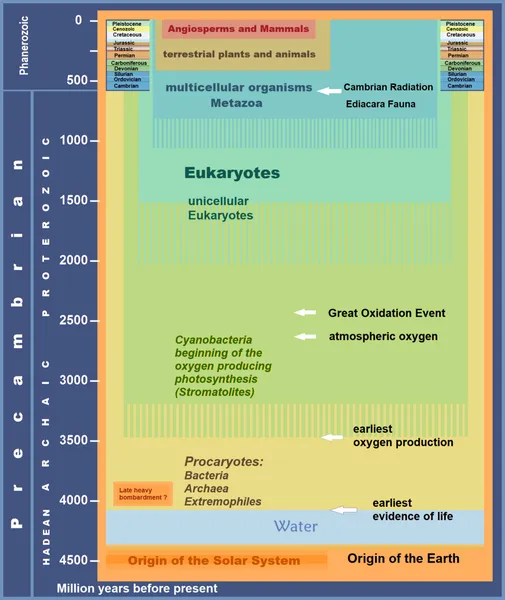
The Great Oxidation Event (GOE) or Great Oxygenation Event, also called the Oxygen Catastrophe, Oxygen Revolution, Oxygen Crisis, or Oxygen Holocaust, was a time interval during the Earth's Paleoproterozoic era when the Earth's atmosphere and shallow seas first experienced a rise in the concentration of free oxygen. This began approximately 2.46–2.426 billion years ago (Ga) during the Siderian period and ended around 2.06 billion years ago during the Rhyacian. Geological, isotopic, and chemical evidence suggests that biologically produced molecular oxygen (dioxygen or O2) started to accumulate in the Archean prebiotic atmosphere by microbial photosynthesis. It changed the atmosphere from a weakly reducing state practically devoid of oxygen into an oxidizing one containing abundant free oxygen, with oxygen levels being as high as 10% of the modern atmospheric level by the end of the GOE.
Also on this shelf
Bearcat Ridge.
Coldwater Lake (Washington).
See also
Uncatalogued shelfText from Wikipedia; plate via Wikimedia Commons. Text CC BY-SA 4.0; plate freely licensed (see Commons). Source record. Images and catalogue data are reproduced from open-access collections.