Geology and Minerals
Imperial topaz
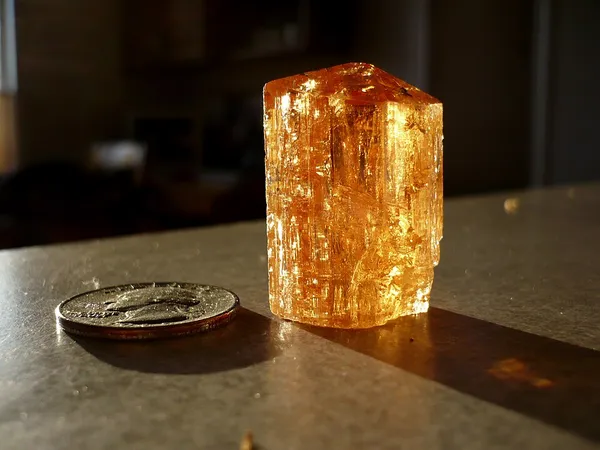
Imperial topaz is a highly prized gem variety of the mineral topaz, distinguished by its warm golden, orange, and reddish-pink hues. It is classified as a nesosilicate with the chemical formula Al2SiO4(F,OH)2 and crystallises in the orthorhombic crystal system. The great majority of gem-quality material comes from a single mining district near Ouro Preto in the Brazilian state of Minas Gerais, where topaz-bearing rhyolite breccias have been exploited since the early eighteenth century. Imperial topaz is also known in the trade as precious topaz, a designation that distinguishes it from the more common blue, colourless, and yellow varieties whose lower values dominate the commercial market. The name reflects close historical associations with royalty. Competing traditions link it either to the Russian Imperial court, whose members are said to have reserved pinkish-orange topaz from the Ural Mountains for exclusive use by the tsar's family, or to the Brazilian imperial household during the reign of Dom Pedro II. Both narratives remain in circulation, and neither has been definitively established as the primary source of the designation. Among all topaz varieties, natural red and reddish-orange stones of imperial quality represent less than 0.5 percent of faceted material found worldwide. This scarcity, combined with the colour stability of untreated specimens, keeps imperial topaz among the most commercially valuable silicate gemstones.
Also on this shelf
Lava lake.
Chesterville gold mine.
See also
Uncatalogued shelfText from Wikipedia; plate via Wikimedia Commons. Text CC BY-SA 4.0; plate freely licensed (see Commons). Source record. Images and catalogue data are reproduced from open-access collections.