Geology and Minerals
Geilston Bay fossil site
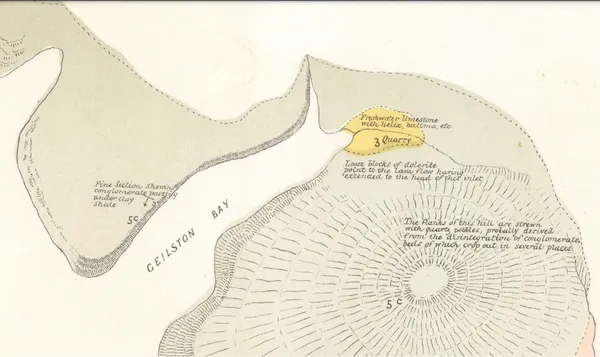
The Geilston Bay fossil site is a paleontological site of Late Oligocene (or possibly Early Miocene) age in south-eastern Tasmania, Australia. It lies within the suburb of Geilston Bay which, although it is a part of the municipality (city) of Clarence, is effectively a suburb of Hobart located on the eastern shore of the River Derwent. The Geilston Bay site is important as one of the few of its age to yield fossils of mammals from the Late Paleogene Period (earliest Tertiary); at the time of their redescription in 1975, the mammal (marsupial) fossils were considered the earliest then known from Australia, although that distinction has since been surrendered to fossils from the Murgon fossil site in south-east Queensland, whose fauna—known as the Tingamarra Fauna—is of Early Eocene age. In addition to the somewhat fragmentary mammal bones still in existence, a range of plant macrofossils have also been described from the site, which appear not to have survived. The limestone deposit (in a form known as travertine) in which the fossils occurred was extensively mined (possibly completely) for the production of lime in the nineteenth and early twentieth centuries, and its location, while still publicly accessible, now lies buried beneath landfill under the playing fields of the former Geilston Bay High School.
Also on this shelf
Easy Peak.
Coldwater Sandstone.
See also
Uncatalogued shelfText from Wikipedia; plate via Wikimedia Commons. Text CC BY-SA 4.0; plate freely licensed (see Commons). Source record. Images and catalogue data are reproduced from open-access collections.