Geology and Minerals
Cornwall
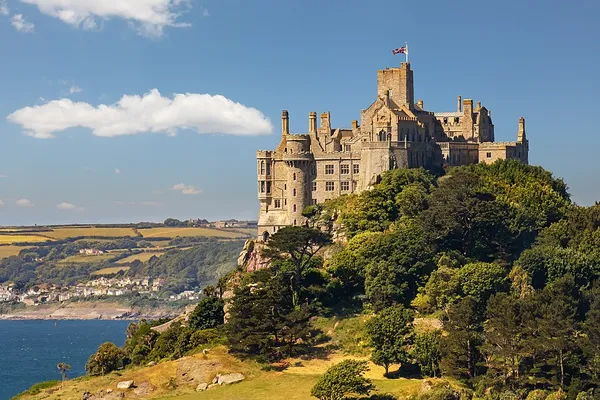
Cornwall (; Cornish: Kernow [ˈkɛrnɔʊ] or [ˈkɛrnɔ]) is a ceremonial county in South West England. It is one of the Celtic nations and the homeland of the Cornish people. The county is bordered by the Atlantic Ocean to the north and west, Devon to the east, and the English Channel to the south. The largest urban area is the Redruth and Camborne conurbation. The county is predominantly rural, with an area of 1,375 square miles (3,562 km2) and an estimated population of 585,655 in 2024. The county's major settlements include the city of Truro and St Austell in the centre, Redruth and Camborne adjacent to each other in the southwest, Saltash in the extreme southeast, and Penzance and Falmouth on the southern coast. For local government purposes, most of Cornwall is a unitary authority area, with the Isles of Scilly governed by a unique local authority. The Cornish nationalist movement disputes the constitutional status of Cornwall and seeks greater autonomy within the United Kingdom. Cornwall is the westernmost part of the South West Peninsula, and the southernmost county within the United Kingdom. Its coastline is characterised by steep cliffs and, to the south, several rias, including those at the mouths of the rivers Fal and Fowey. It includes the southernmost point on Great Britain, Lizard Point, and forms a large part of the Cornwall National Landscape. The national landscape also includes Bodmin Moor, an upland outcrop of the Cornubian batholith granite formation. The county contains many short rivers; the longest is the Tamar, which forms the border with Devon. Cornwall had a minor Roman presence, and later formed part of the Brittonic kingdom of Dumnonia. From the 7th century, the Britons in the South West increasingly came into conflict with the expanding Anglo-Saxon kingdom of Wessex, eventually being pushed west of the Tamar, where the boundary was set by King Æthelstan in 936. By the time of the Norman Conquest, Cornwall was administered as part of England, though it retained its own culture. The remainder of the Middle Ages and Early Modern Period were relatively settled, with Cornwall developing its tin mining industry and becoming a duchy in 1337. During the Industrial Revolution, the tin and copper mines were expanded and then declined, with china clay extraction becoming a major industry.
Also on this shelf
Arabian-Nubian Shield.
Dinosaur National Monument.
See also
Uncatalogued shelfText from Wikipedia; plate via Wikimedia Commons. Text CC BY-SA 4.0; plate freely licensed (see Commons). Source record. Images and catalogue data are reproduced from open-access collections.