Geology and Minerals
Camarasaurus
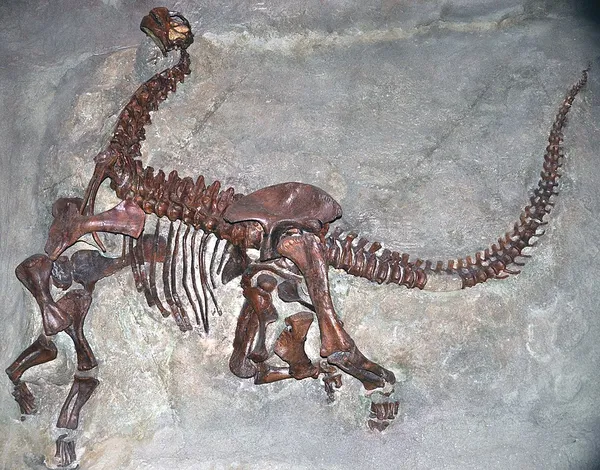
Camarasaurus ( KAM-ər-ə-SOR-əs) is a genus of sauropod dinosaur that lived during the Late Jurassic (Kimmeridgian to Tithonian ages, c. 155 to 143 million years ago) in North America. Over 530 specimens have been found in rocks of the Morrison Formation in the western United States, including several nearly complete skeletons. It is the most common dinosaur in the Morrison Formation and one of the best understood sauropods. Camarasaurus was a bulky sauropod with a proportionally wide rib cage. Its skull was proportionally larger and more strongly built than that of other sauropods, with powerful jaws that allowed for high bite forces. It had 13–14 teeth on each side of the upper jaw and 13 teeth on each side of the lower jaw. The teeth were spoon-shaped, tilted forwards, and rapidly replaced. Camarasaurus was probably a selective feeder that fed at heights of 2 to 5 m (7 to 16 ft). Specimens range from a presumed embryo to an individual that probably reached 40 years of age, one of the oldest reported ages for an individual dinosaur. Skin impressions have been found on one specimen, and several specimens show signs of injury or disease, such as bite marks and arthritis. Individuals might have seasonally migrated to avoid the dry season in the Morrison basin. The name Camarasaurus means 'chambered lizard', referring to the chambers in the vertebrae of the neck and back. The genus was named in 1877 by Edward Drinker Cope, based on fossils from Garden Park, Colorado. Soon after, Cope's rival Othniel Charles Marsh named the new genus Morosaurus from specimens found in Como Bluff, Wyoming. Morosaurus and its species were later assigned to Camarasaurus. Probably in 1879, a life-sized drawing of the reconstructed skeleton was made, the oldest known reconstruction of a sauropod. From 1909, several largely complete skeletons have been discovered in Carnegie Quarry at what is now Dinosaur National Monument; some specimens, including a nearly complete skull, remain in the quarry wall. Four species are commonly recognized: C. supremus, C. grandis, C. lentus, and C. lewisi. The most common species, C. lentus, was around 15 m (49 ft) in length; C. supremus was considerably larger. C. supremus might have been the youngest species, mostly occurring at the top of the Morrison Formation. Camarasaurus is a member of the group Macronaria.
Also on this shelf
Euclid Creek.
Coos Bay.
See also
Uncatalogued shelfText from Wikipedia; plate via Wikimedia Commons. Text CC BY-SA 4.0; plate freely licensed (see Commons). Source record. Images and catalogue data are reproduced from open-access collections.