Geology and Minerals
Hubbert peak theory
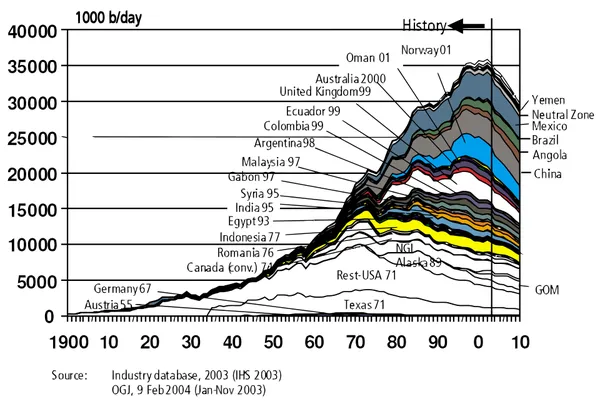
The Hubbert peak theory says that for any given geographical area, from an individual oil-producing region to the planet as a whole, the rate of petroleum production tends to follow a bell-shaped curve. It is one of the primary theories on peak oil. Choosing a particular curve determines a point of maximum production based on discovery rates, production rates, and cumulative production. Early in the curve (pre-peak), the production rate increases due to the discovery rate and the addition of infrastructure. Late in the curve (post-peak), production declines because of resource depletion. The Hubbert peak theory is based on the observation that the amount of oil under the ground in any region is finite; therefore, the rate of discovery, which initially increases quickly, must reach a maximum and then decline. In the US, oil extraction followed the discovery curve after a time lag of 32 to 35 years. The theory is named after American geophysicist M. King Hubbert, who created a method of modeling the production curve given an assumed ultimate recovery volume.
Also on this shelf
Belt Supergroup.
Archean.
See also
Uncatalogued shelfText from Wikipedia; plate via Wikimedia Commons. Text CC BY-SA 4.0; plate freely licensed (see Commons). Source record. Images and catalogue data are reproduced from open-access collections.