Geology and Minerals
Clastic dike
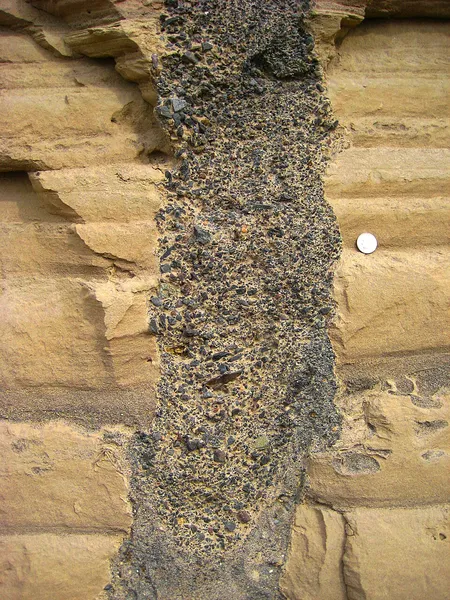
A clastic dike is a seam of sedimentary material that fills an open fracture in and cuts across sedimentary rock strata or layering in other rock types. Clastic dikes form rapidly by fluidized injection (mobilization of pressurized pore fluids) or passively by water, wind, and gravity (sediment swept into open cracks). Diagenesis may play a role in the formation of some dikes. Clastic dikes are commonly vertical or near-vertical. Centimeter-scale widths are common, but thicknesses range from millimetres to metres. Length is usually many times width. Clastic dikes are found in sedimentary basin deposits worldwide. Formal geologic reports of clastic dikes began to emerge in the early 19th century. Terms synonymous with clastic dike include: clastic intrusion, sandstone dike, fissure fill, soft-sediment deformation, fluid escape structure, seismite, injectite, liquefaction feature, neptunian dike (passive fissure fills), paleoseismic indicator, pseudo ice wedge cast, sedimentary insertion, sheeted clastic dike, synsedimentary filling, tension fracture, hydraulic injection dike, and tempestite.
Also on this shelf
Calbuco (volcano).
Elk Point Group.
See also
Uncatalogued shelfText from Wikipedia; plate via Wikimedia Commons. Text CC BY-SA 4.0; plate freely licensed (see Commons). Source record. Images and catalogue data are reproduced from open-access collections.