Geology and Minerals
Europium
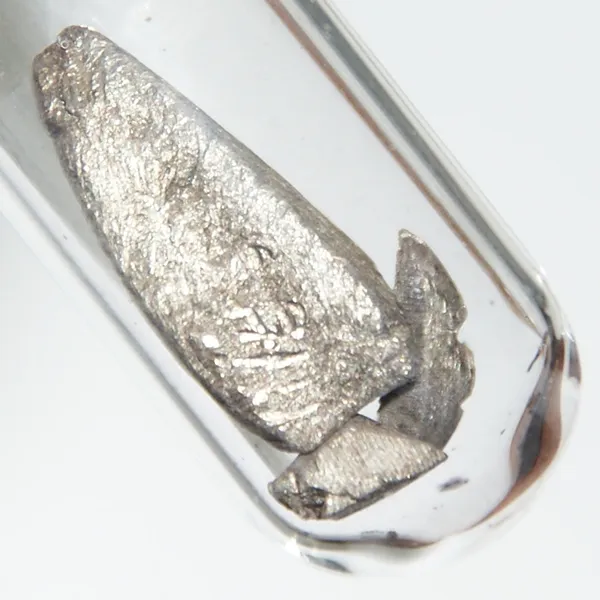
Europium is a chemical element; it has symbol Eu and atomic number 63. It is a soft, silvery-white lanthanide metal that tarnishes rapidly in air and is the most chemically reactive of the lanthanides. Europium has an unusually low density and large atomic volume for a lanthanide because the metal is effectively divalent, unlike the predominantly trivalent neighbouring elements. Its half-filled 4f7 electron configuration also gives elemental europium distinctive magnetic properties; it is paramagnetic at room temperature and becomes antiferromagnetic below about 91 K. In compounds, the +3 oxidation state is generally the most stable, but europium has the most readily accessible +2 state of any lanthanide. Europium does not occur naturally as the free metal and is found only as a minor component of rare-earth minerals such as bastnäsite, monazite and xenotime. Its ability to form Eu(II) gives it unusual geochemical behaviour: europium can be preferentially incorporated into feldspar, producing positive or negative europium anomalies that are widely used in petrology and geochemistry. Naturally occurring europium consists of two isotopes in nearly equal proportions, 151Eu and 153Eu. 153Eu is observationally stable, while 151Eu is a very long-lived alpha emitter with a half-life of about 4.6×10¹⁸ years. The identification of europium formed part of the long 19th-century process of separating the rare-earth elements. William Crookes observed an unexplained spectral feature in rare-earth material in 1885, and Paul Émile Lecoq de Boisbaudran reported a further unidentified line in samarium in 1892. In 1896, the French chemist Eugène-Anatole Demarçay reported evidence for a new element associated with samarium; after repeated fractional crystallisation, he obtained it in sufficiently pure form in 1901 and named it europium after Europe. Elemental europium metal was prepared several decades later. The major applications of europium exploit its luminescence. Eu(III) produces narrow orange-red emission lines, whereas Eu(II) gives broad, host-dependent emission that can span much of the visible spectrum. Europium phosphors became commercially important in the 1960s as red emitters in colour television and remain important in lighting, light-emitting diodes, display technologies, persistent luminescent materials and radiation detectors.
Also on this shelf
Borra Caves.
Fayetteville, Arkansas.
See also
Uncatalogued shelfText from Wikipedia; plate via Wikimedia Commons. Text CC BY-SA 4.0; plate freely licensed (see Commons). Source record. Images and catalogue data are reproduced from open-access collections.