Geology and Minerals
Bryozoa
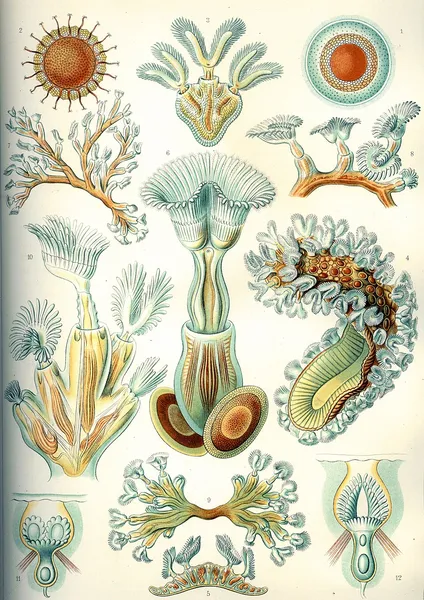
The Bryozoa (also known as the Polyzoa, Ectoprocta or commonly as moss animals) are a phylum of simple, aquatic invertebrate animals, nearly all living in sedentary colonies. Typically about 0.5 millimetres (1⁄64 in) long, they have a special feeding structure called a lophophore, a "crown" of tentacles used for filter feeding. The bryozoa are classified as the marine bryozoa (Stenolaemata), freshwater bryozoa (Phylactolaemata), and mostly-marine bryozoa (Gymnolaemata), a few members of which prefer brackish water. Most marine bryozoans live in tropical waters, but a few are found in oceanic trenches and polar waters. 5,869 living species of bryozoa are known. Originally all of the crown group Bryozoa were colonial, but as an adaptation to a mesopsammal (interstitial spaces in marine sand) life or to deep-sea habitats, secondarily solitary forms have since evolved. Five genera are solitary: Aethozooides, Aethozoon, Franzenella, Solella, which together make up the family Aethozoidae, and Monobryozoon, which has a statocyst-like organ with a supposed excretory function. The terms Polyzoa and Bryozoa were introduced in 1830 and 1831, respectively. Soon after it was named, another group of animals was discovered whose filtering mechanism looked similar, so it was included in Bryozoa until 1869, when the two groups were noted to be very different internally. The new group was given the name "Entoprocta", while the original Bryozoa were called "Ectoprocta". Disagreements about terminology persisted well into the 20th century, but "Bryozoa" is now the generally accepted term. Colonies take a variety of forms, including fans, bushes and sheets. Single animals, called zooids, live throughout the colony and are not fully independent. These individuals can have unique and diverse functions. All colonies have "autozooids", which are responsible for feeding, excretion, and supplying nutrients to the colony through diverse channels. Some classes have specialist zooids like hatcheries for fertilized eggs, colonial defence structures, and root-like attachment structures. Cheilostomata is the most diverse order of bryozoan, possibly because its members have the widest range of specialist zooids.
Also on this shelf
Fossil collecting.
Alcedo Volcano.
See also
Uncatalogued shelfText from Wikipedia; plate via Wikimedia Commons. Text CC BY-SA 4.0; plate freely licensed (see Commons). Source record. Images and catalogue data are reproduced from open-access collections.