Geology and Minerals
Cambrian
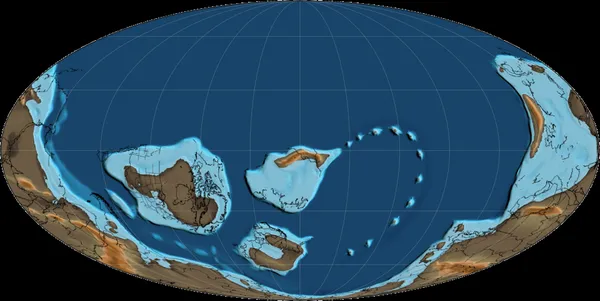
The Cambrian ( KAM-bree-ən, KAYM-) is the first geological period of the Paleozoic Era and the Phanerozoic Eon. The Cambrian lasted 51.95 million years from the end of the preceding Ediacaran Period 538.8 Ma (million years ago) to the beginning of the Ordovician Period 486.85 Ma. Most of the continents were located in the southern hemisphere surrounded by the vast Panthalassa Ocean. The assembly of Gondwana during the Ediacaran and early Cambrian led to the development of new convergent plate boundaries and continental-margin arc magmatism along its margins that helped drive up global temperatures. Laurentia lay across the equator, separated from Gondwana by the opening Iapetus Ocean. The Cambrian marked a profound change in life on Earth; prior to the period, the majority of living organisms were small, unicellular, and poorly preserved. Complex, multicellular organisms gradually became more common during the Ediacaran, but it was not until the Cambrian that fossil diversity seems to have rapidly increased, an event known as the Cambrian explosion, producing the first representatives of most modern animal phyla. The period is also unique in its unusually high proportion of lagerstätte deposits, sites of exceptional preservation where "soft" parts of organisms are preserved as well as their more resistant shells.
Also on this shelf
Adigrat Sandstone.
Bend Arch–Fort Worth Basin.
See also
Uncatalogued shelfText from Wikipedia; plate via Wikimedia Commons. Text CC BY-SA 4.0; plate freely licensed (see Commons). Source record. Images and catalogue data are reproduced from open-access collections.