Geology and Minerals
Geology of Ceres
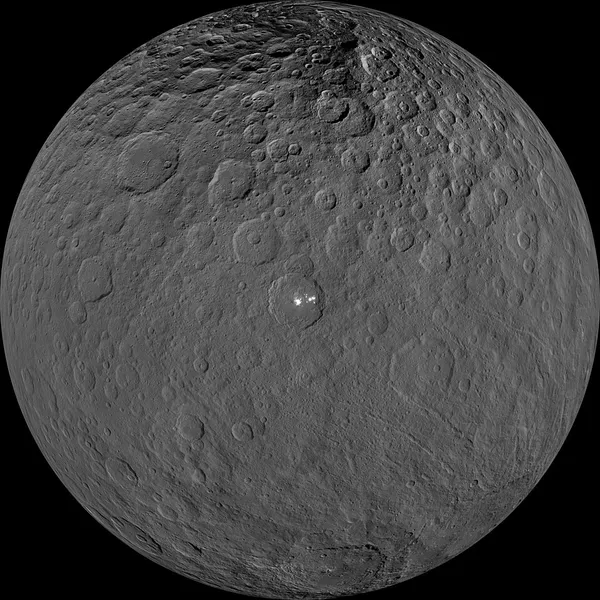
The geology of Ceres is the scientific study of the surface, crust, and interior of the dwarf planet Ceres. It seeks to understand and describe Ceres' composition, landforms, evolution, and physical properties and processes. The study draws on fields such as geophysics, remote sensing, geochemistry, geodesy, and cartography (see Planetary geology). Before the arrival of NASA's Dawn spacecraft in 2015, knowledge of Ceres' geology was limited to spectroscopic studies from Earth-orbital and ground-based telescopes, which tentatively identified the dwarf planet's overall surface composition. Thermodynamic models of Ceres' interior and evolution were also constructed based on properties such as its shape and bulk density. Data from the Dawn mission not only confirmed many of the results of earlier studies, but dramatically increased the understanding of Ceres' composition and evolution, moving it from a largely astronomical object to a geological one. At a diameter of 964 km, Ceres is the largest object in the main asteroid belt and comprises about one-third of the belt's total mass. Ceres possesses sufficient gravity to form a rounded, ellipsoid shape, suggesting that it is close to being in hydrostatic equilibrium—one of the conditions for defining a dwarf planet according to the International Astronomical Union (IAU). Though large relative to asteroids, Ceres is small compared with many other solid bodies in the Solar System. For example, it is only 28% the size of Earth's Moon and 41% that of Pluto, another dwarf planet. It is comparable in size to Saturn's moons Tethys and Dione. Ceres' small size means that it cooled much faster than full-sized planets and larger moons, limiting its degree of thermal evolution. Ceres' mean density of 2,162 kg/m3 is midway between rock (~3,000 kg/m3) and ice (~1,000 kg/m3). This implies that water in some form makes up 17–27% of its total mass. The water is present both as ice and in hydrated minerals. Being the most water-rich body in the inner Solar System after Earth, Ceres is believed to have once hosted a subsurface ocean, the remnant of which may still exist as a global reservoir or as pockets of brines (salty water) at depth.
Also on this shelf
Geography of Karnataka.
Imperial topaz.
See also
Uncatalogued shelfText from Wikipedia; plate via Wikimedia Commons. Text CC BY-SA 4.0; plate freely licensed (see Commons). Source record. Images and catalogue data are reproduced from open-access collections.