Geology and Minerals
Geology of Mercury
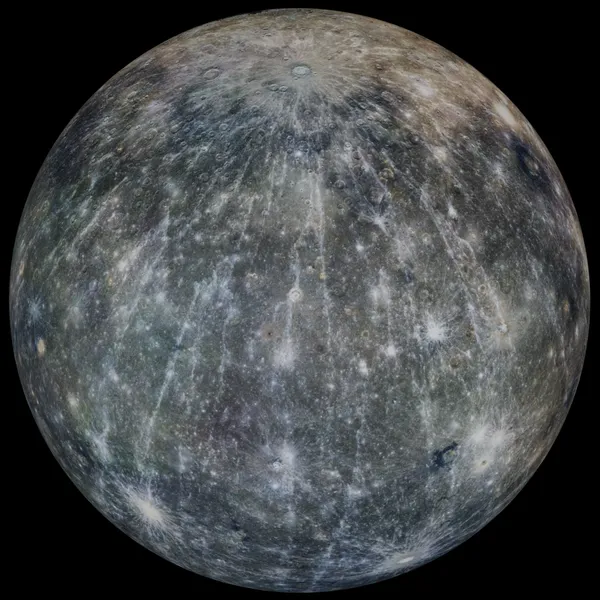
The geology of Mercury is the scientific study of the surface, crust, and interior of the planet Mercury. It emphasizes the composition, structure, history, and physical processes that shape the planet. It is analogous to the field of terrestrial geology. In planetary science, the term geology is used in its broadest sense to mean the study of the solid parts of planets and moons. The term incorporates aspects of geophysics, geochemistry, mineralogy, geodesy, and cartography. Historically, Mercury has been the least understood of all the terrestrial planets in the Solar System. This stems largely from its proximity to the Sun which makes reaching it with spacecraft technically challenging and Earth-based observations difficult. For decades, the principal source of geologic information about Mercury came from the 2,700 images taken by the Mariner 10 spacecraft during three flybys of the planet from 1974 to 1975. These images covered about 45% of the planet's surface, but many of them were unsuitable for detailed geologic investigation because of high sun angles which made it hard to determine surface morphology and topography. This dearth of information was greatly alleviated by the Mercury Surface, Space Environment, Geochemistry, and Ranging (MESSENGER) spacecraft which between 2008 and 2015 collected over 291,000 images covering the entire planet, along with a wealth of other scientific data. The European Space Agency's (ESA's) BepiColombo spacecraft, scheduled to go into orbit around Mercury in 2026, is expected to help answer many of the remaining questions about Mercury's geology. Mercury's surface is dominated by impact craters, basaltic rock and smooth plains, many of them a result of flood volcanism, similar in some respects to the lunar maria, and locally by pyroclastic deposits. Other notable features include vents which appear to be the source of magma-carved valleys, often-grouped irregular-shaped depressions termed "hollows" that are believed to be the result of collapsed magma chambers, scarps indicative of thrust faulting, and mineral deposits (possibly ice) inside craters at the poles. Although Mercury has been long thought geologically inactive, new evidence suggests there may still be some level of activity. Mercury's density implies a solid iron-rich core that accounts for about 60% of its volume (75% of its radius).
Also on this shelf
David Dale Owen.
Abiquiu Formation.
See also
Uncatalogued shelfText from Wikipedia; plate via Wikimedia Commons. Text CC BY-SA 4.0; plate freely licensed (see Commons). Source record. Images and catalogue data are reproduced from open-access collections.