Geology and Minerals
Geology of the Palatinate Forest
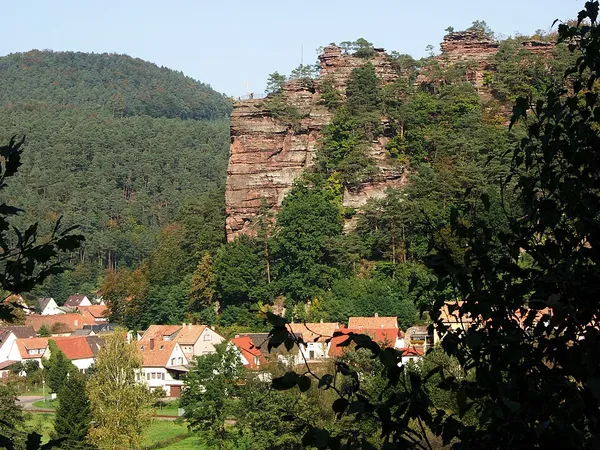
The geology of the Palatinate Forest, in Germany, is primarily characterized by sedimentary rock layers from the Buntsandstein (Lower Triassic) and, to a lesser extent, the Zechstein (Upper Permian), deposited between 256 and 243 million years ago under predominantly arid conditions. These rocks include fine- to coarse-grained and conglomeratic sediments of varying strength, density, and color. Highly consolidated, silica-bearing medium- and coarse-grained sandstones, such as those in the Trifels Formation of the Lower Buntsandstein, are common, alongside fine-grained sandstones with clay-rich binding, like those in the Annweiler Formation of the Upper Zechstein. The rock formations are divided into zones with uniform structures (e.g., Trifels Formation) and those with heterogeneous structures, such as the Rehberg Formation in the Lower Buntsandstein, where sediment structures vary within small areas. Approximately 48 million years ago, during the Paleogene, the Upper Rhine Plain began to subside, causing tectonic rearrangement of these rock formations. They were unevenly uplifted, fragmented into blocks, and the Buntsandstein was exposed and tilted. The current landscape of the Buntsandstein package took shape during the late Cenozoic (5 to 0.01 million years ago), forming a complex relief with deeply incised valleys, diverse mountain forms, and nutrient-poor soils supporting dense forests. In the southern Palatinate Forest, a varied rocky landscape emerged, featuring conical hills and striking rock formations, such as those in the Annweiler and Dahn rockland.
Also on this shelf
2018 in paleontology.
Carachipampa.
See also
Uncatalogued shelfText from Wikipedia; plate via Wikimedia Commons. Text CC BY-SA 4.0; plate freely licensed (see Commons). Source record. Images and catalogue data are reproduced from open-access collections.