Geology and Minerals
Belomorite
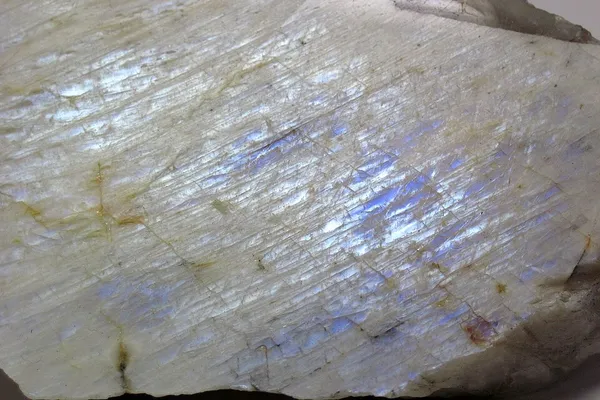
Belomorite (Russian: беломорит), sometimes peristerite, moonstone, murchisonite, Ceylon opal, or hecatolite, is a decorative variety of albite (oligoclase) of white or light gray color with a distinct iridescence effect. By composition, belomorite belongs to the feldspar family; it is a sodium aluminosilicate from the plagioclase group, in most cases belonging to the isomorphic series albite (Ab) — anorthite (An) with an approximate percentage of 70Ab-30An. The name “belomorite” was given to this variety of albite by academician Alexander Fersman in 1925, based on the location of its discovery near the shore of the White Sea (Russian: Белое море, romanized: Beloye more), and also, by association, for the similarity of iridescence colors with the shades of sea water. The best varieties of belomorite are translucent or transparent, they have a pearl-glass luster and iridescence in blue, gray-blue, violet-blue, greenish-blue or pale violet tones. The most famous deposits of this gem are in the north, in the pegmatites of the Kola Peninsula and Karelia. Belomorite is a popular jewelry and ornamental material, one of the varieties of moonstone. However, due to its fragility and perfect cleavage, the mineral often breaks and is difficult to process, so it is cut in the form of simple cabochons (oval, round, teardrop-shaped), as well as balls or polished plates.
Also on this shelf
Bryozoa.
Kamoamoa.
See also
Uncatalogued shelfText from Wikipedia; plate via Wikimedia Commons. Text CC BY-SA 4.0; plate freely licensed (see Commons). Source record. Images and catalogue data are reproduced from open-access collections.