Geology and Minerals
Grand Kankakee Marsh
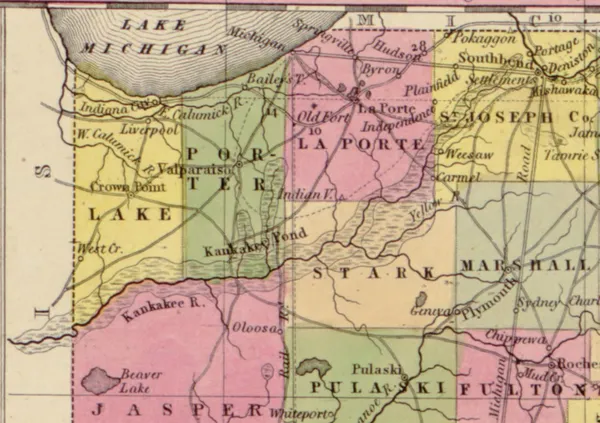
The Grand Kankakee Marsh (or Great Kankakee Marsh or Kankakee Marsh) of northern Indiana and northern Illinois was one of the largest wetlands and freshwater marshes in the contiguous United States, and was frequently referred to as "The Everglades of the North". The marsh was formed by melting glaciers during the Late Pleistocene, approximately 13,000 to 16,000 Years Before Present (YBP). It was the home of Indigenous nations for thousands of years until the Indian Removal Act in the 19th century. The marsh existed within the Kankakee River drainage basin's 5,165 square miles (13,380 km2). Its estimated size ranged between 400,000 acres (160,000 ha) to over 1 million acres (404,686 ha) across 1,600 square miles (4,100 km2), and its main tributary, the Kankakee, was over 240 miles (390 km) long with over 2,000 meander bends. Its flat elevation of 1.3 feet per mile (0.25 m/km) maintained the land wet most of the year. The Kankakee Marsh was a mosaic of marsh, swamp, bog, fen, forest, prairie, wet meadow, oak savanna, and barren vegetation. Countless fish, reptiles, amphibians, insects, invertebrates, birds, and semi-aquatic mammals inhabited the marsh. Its habitats consisted of vast, open stretches of shallow water with island ridges, aquatic plants (e.g., cattails, wild rice), shrubs (e.g., willows, dogwoods), and trees (e.g., maples, oaks). Notable features included English Lake, formed by the confluence of the Kankakee and Yellow rivers, and Beaver Lake, the largest lake in Indiana until the 1880s. The marsh provided spawning grounds for fish from the Illinois River. American settlers, syndicates, land speculators, and the Indiana General Assembly gradually destroyed the marsh between 1882 and 1917 by channelizing rivers and streams. The Kankakee River became one of the largest drainage ditches in the U.S. The draining of the marsh turned it into a major agricultural region, enabling its nine counties in 2022 to generate over $1.6 billion from crop revenues and over $847 million from livestock revenues. The channelization of the Kankakee River has caused serious environmental issues over the last century, including floods and erosion.
Also on this shelf
Adigrat Sandstone.
Kurile Lake.
See also
Uncatalogued shelfText from Wikipedia; plate via Wikimedia Commons. Text CC BY-SA 4.0; plate freely licensed (see Commons). Source record. Images and catalogue data are reproduced from open-access collections.