Geology and Minerals
Dickite
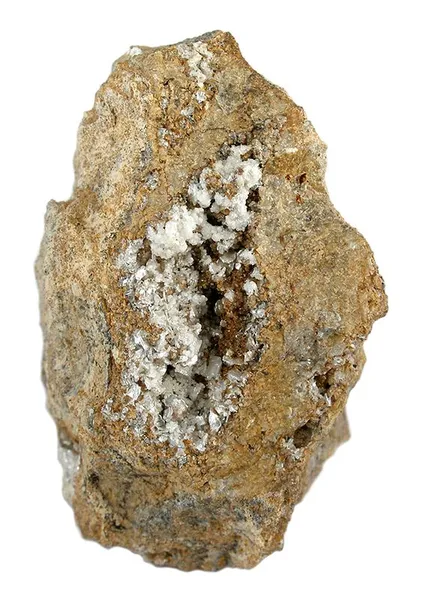
Dickite (Al2Si2O5(OH)4) is a phyllosilicate clay mineral named after the metallurgical chemist Allan Brugh Dick, who first described it. It is chemically composed of 20.90% aluminium, 21.76% silicon, 1.56% hydrogen and 55.78% oxygen. It has the same composition as kaolinite, nacrite, and halloysite, but with a different crystal structure (polymorph). Dickite sometimes contains impurities such as titanium, iron, magnesium, calcium, sodium and potassium. Dickite occurs with other clays and requires x-ray diffraction for its positive identification. Dickite is an important alteration indicator in hydrothermal systems as well as occurring in soils and shales. Dickite's type location is in Pant-y-Gaseg, Amlwch, Isle of Anglesey, Wales, United Kingdom, where it was first described in 1888. Dickite appears in locations with similar qualities and is found in China, Jamaica, France, Germany, United Kingdom, United States, Italy, Belgium and Canada.
Also on this shelf
Geological deformation of Iceland.
Geography of New Jersey.
See also
Uncatalogued shelfText from Wikipedia; plate via Wikimedia Commons. Text CC BY-SA 4.0; plate freely licensed (see Commons). Source record. Images and catalogue data are reproduced from open-access collections.