Geology and Minerals
Cerro Panizos
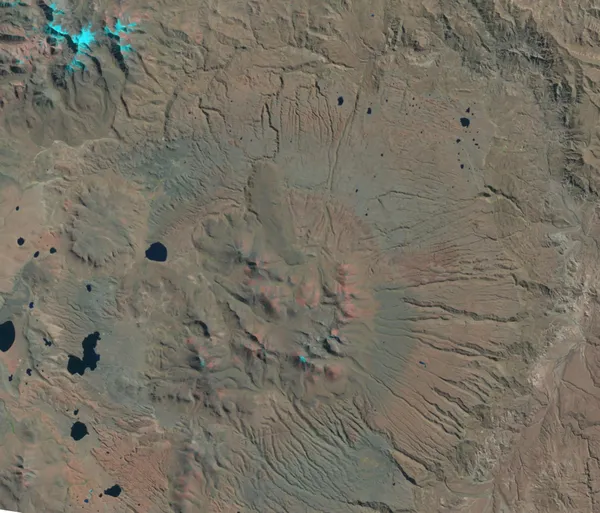
Cerro Panizos (Spanish: [ˈse.ro paˈni.sos], "Maize Hill") is a late Miocene-age shield-shaped volcano spanning the Potosi Department of Bolivia and the Jujuy Province of Argentina. It features two calderas (depressions formed by the collapse of a volcano) and a group of lava domes. It is part of the Altiplano–Puna volcanic complex (APVC), a group of calderas and associated ignimbrites (a form of volcanic rock) that erupted during the past ten million years. Cerro Panizos is part of the Central Volcanic Zone (CVZ), a volcanic arc that extends from Peru to Chile that was formed mostly by subduction of the Nazca Plate beneath South America. Volcanic activity commenced in the APVC about ten million years ago, producing the volcano Uturuncu and the large volcanic calderas Panizos, Vilama, and Cerro Guacha. The formation of the APVC has been linked to the existence of a giant magmatic body in the crust of the Central Andes. The Cienago Ignimbrite erupted over 350 cubic kilometres (84 mi3) from Panizos about 7.9 million years ago, and 6.7 million years ago the Panizos Ignimbrite erupted over 650 cubic kilometres (160 mi3). The Panizos Ignimbrite has been noted for volcanic rocks containing orbs. Several volcanic cones such as Limitayoc were active between the ignimbrite eruptions, and a plateau of lava flows and lava domes formed in the central area of the Panizos Ignimbrite after the last eruptions.
Also on this shelf
Conasauga shale.
Fairbanks, Alaska.
See also
Uncatalogued shelfText from Wikipedia; plate via Wikimedia Commons. Text CC BY-SA 4.0; plate freely licensed (see Commons). Source record. Images and catalogue data are reproduced from open-access collections.