Geology and Minerals
Extrusive rock
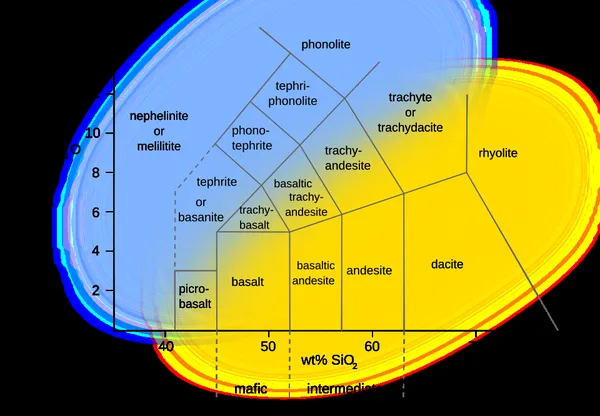
Extrusive rock refers to the mode of igneous volcanic rock formation in which hot magma from inside the Earth flows out (extrudes) onto the surface as lava or explodes violently into the atmosphere to fall back as pyroclastics or tuff. In contrast, intrusive rock refers to rocks formed by magma which cools below the surface. The main effect of extrusion is that the magma can cool much more quickly in the open air or under seawater, and there is little time for the growth of crystals. Sometimes, a residual portion of the matrix fails to crystallize at all, instead becoming a natural glass like obsidian. If the magma contains abundant volatile components which are released as free gas, then it may cool with large or small vesicles (bubble-shaped cavities) such as in pumice, scoria, or vesicular basalt. Other examples of extrusive rocks are rhyolite and andesite.
Also on this shelf
Brazilianite.
Frank Hawthorne.
See also
Uncatalogued shelfText from Wikipedia; plate via Wikimedia Commons. Text CC BY-SA 4.0; plate freely licensed (see Commons). Source record. Images and catalogue data are reproduced from open-access collections.