Geology and Minerals
Diatomaceous earth
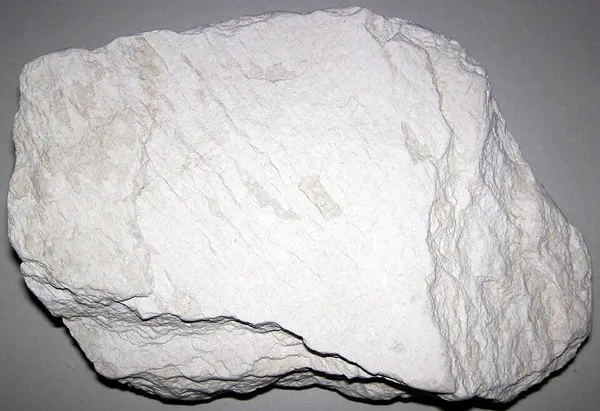
Diatomaceous earth ( DY-ə-tə-MAY-shəs), also known as diatomite ( dy-AT-ə-myte), celite, or kieselgur, is a naturally occurring, soft, siliceous sedimentary rock that can be crumbled into a fine white to off-white powder. It has a particle size ranging from more than 3 mm to less than 1 μm, but typically 10 to 200 μm. Depending on the granularity, this powder can have an abrasive feel, like that of pumice powder, and has a low density as a result of its high porosity. The typical chemical composition of oven-dried diatomaceous earth is 80–90% silica, with 2–4% alumina (attributed mostly to clay minerals), and 0.5–2% iron oxide. Diatomaceous earth consists of the fossilized remains of diatoms, a type of hard-shelled microalgae, that have accumulated over millions of years. It is used as a filtration aid, mild abrasive in products including metal polishes and toothpaste, mechanical insecticide, absorbent for liquids, matting agent for coatings, reinforcing filler in plastics and rubber, anti-block in plastic films, porous support for chemical catalysts, cat litter, activator in coagulation studies, stabilizing component of dynamite, thermal insulator, and soil for potted plants and trees as in the art of bonsai. It is also used in gas chromatography packed columns made with glass or metal as stationary phase.
Also on this shelf
Archean felsic volcanic rocks.
Avala.
See also
Uncatalogued shelfText from Wikipedia; plate via Wikimedia Commons. Text CC BY-SA 4.0; plate freely licensed (see Commons). Source record. Images and catalogue data are reproduced from open-access collections.