Geology and Minerals
Cretaceous–Paleogene boundary
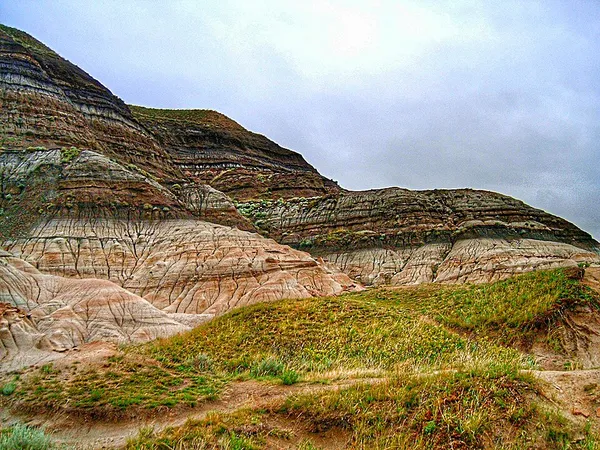
The Cretaceous–Paleogene (K–Pg) boundary, formerly known as the Cretaceous–Tertiary (K–T) boundary, is a geological signature, usually a thin band of rock containing much more iridium than other bands. The K–Pg boundary marks the end of the Cretaceous Period, the last period of the Mesozoic Era, and marks the beginning of the Paleogene Period, the first period of the Cenozoic Era. Its age is usually estimated at 66 million years, with radiometric dating yielding a more precise age of 66.043 ± 0.043 Ma. The K–Pg boundary is associated with the Cretaceous–Paleogene extinction event, a mass extinction which destroyed a majority of the world's Mesozoic species, including all dinosaurs except for some birds. Strong evidence exists that the extinction coincided with a large meteorite impact at the Chicxulub crater and the generally accepted scientific theory is that this impact triggered the extinction event. The word "Cretaceous" is derived from the Latin "creta" (chalk). It is abbreviated K (as in "K–Pg boundary") for its German translation "Kreide" (chalk).
Also on this shelf
Gateway of India.
Colossal Cave (Arizona).
See also
Uncatalogued shelfText from Wikipedia; plate via Wikimedia Commons. Text CC BY-SA 4.0; plate freely licensed (see Commons). Source record. Images and catalogue data are reproduced from open-access collections.