Geology and Minerals
Equatorial layered deposits
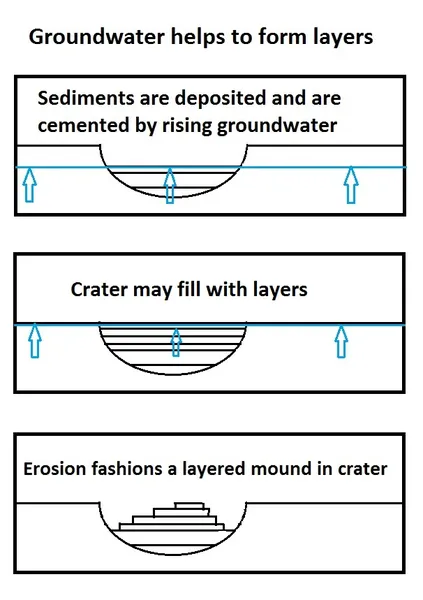
Equatorial layered deposits (ELD’s) have been called interior layered deposits (ILDs) in Valles Marineris. They are often found with the most abundant outcrops of hydrated sulfates on Mars, and thus are likely to preserve a record of liquid water in Martian history since hydrated sulfates are formed in the presence of water. Layering is visible on meter scale, and when the deposits are partly eroded, intricate patterns become visible. The layers in the mound in Gale Crater have been extensively studied from orbit by instruments on the Mars Reconnaissance Orbiter. The Curiosity Rover landed in the crater, and it has brought some ground truth to the observations from satellites. Many of the layers in ELD’s such as in Gale Crater are composed of fine-grained, easily erodible material as are many other layered deposits. On the basis of albedo, erosion patterns, physical characteristics, and composition, researchers have classified different groups of layers in Gale Crater that seem to be similar to layers in other (ELD’s). The groups include: a small yardang unit, a coarse yardang unit, and a terraced unit. Generally, equatorial layered deposits are found ~ ±30° of the equator. Equatorial Layered Deposits appear in various geological settings such as cratered terrains (Arabia Terra, Meridiani Planum), chaotic terrains (Aram Chaos, Aureum Chaos), the Valles Marineris chasmata (and surrounding plateaus), and large impact craters ( Gale, Becquerel, Crommelin). Some ELD’s have been closely studied in Firsoff Crater. Changes in the level of groundwater seem to be the major factor controlling ELD deposition in and around Firsoff Crater. The layers inside Firsoff and other nearby craters would likely have started with fluid upwelling through fissures and mounds, which later lead to evaporite precipitation. Spring and playa deposits suggest the presence of a hydrological cycle, driving groundwater upwelling on Mars at surface temperatures above freezing. Pictures below show some of the layering in Firsoff Crater, which is a candidate for a rover landing in 2020. Many depositional processes have been proposed to explain Equatorial Layered Deposits (ELDs) formation, such as volcanoes under ice, dust from the air, lake deposits, and mineral deposits from springs. Groundwater may have played an important part in forming layers in many locations.
Also on this shelf
Godavari River.
Bolivian tin belt.
See also
Uncatalogued shelfText from Wikipedia; plate via Wikimedia Commons. Text CC BY-SA 4.0; plate freely licensed (see Commons). Source record. Images and catalogue data are reproduced from open-access collections.