Geology and Minerals
Isluga
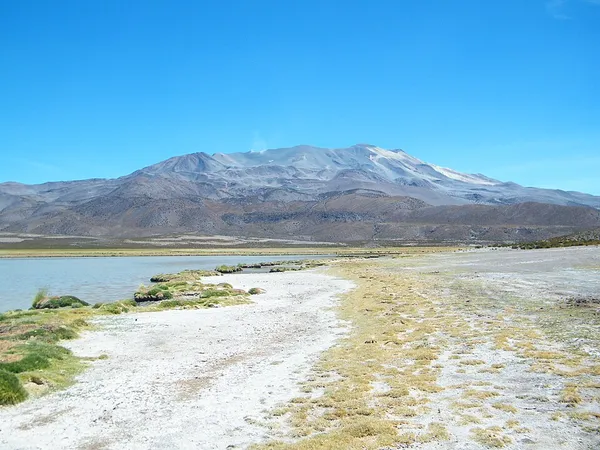
Isluga (Spanish pronunciation: [isˈluɣa]) is a dormant stratovolcano in Chile's Tarapacá Region, close to the border with Bolivia. It is part of the Volcán Isluga National Park and lies in the Central Volcanic Zone of the Andes, one of several volcanic belts in the Andean Volcanic Belt. Isluga is an elongated mountain, whose summit reaches an altitude of 5,559 metres (18,238 ft) above sea level, and features a summit crater. It forms a chain of volcanoes with several of its neighbours in the east. Sulfur mining took place on Isluga in the past. Polylepis trees growing at 4,900 metres (16,100 ft) altitude form the highest timberline on Earth at Isluga. The volcano began to form about half a million years ago during the Pleistocene in multiple stages, and there is evidence of historical eruptions which caused damage to neighbouring settlements. The last clearly attested eruption was in 1913, but more recent events in 1960 and 2005 are possible. Presently, there are conspicuous fumaroles on the volcano that generate gas plumes visible from the foot of the mountain. There are archaeological sites on the mountain and at its foot, and it has religious importance for the surrounding people.
Also on this shelf
Geology of Russia.
Bare Hills Historic District.
See also
Uncatalogued shelfText from Wikipedia; plate via Wikimedia Commons. Text CC BY-SA 4.0; plate freely licensed (see Commons). Source record. Images and catalogue data are reproduced from open-access collections.