Botany
Aquilegia shockleyi
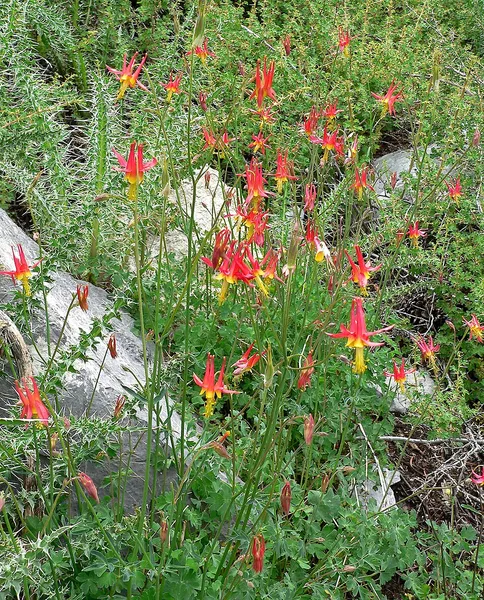
Aquilegia shockleyi, commonly known as Shockley's columbine, the Mojave columbine, and the desert columbine, is a species of perennial flowering plant of the genus Aquilegia (columbine) in the family Ranunculaceae. It is native to southern Nevada and southeastern California in the United States, where it congregates around wet areas. A. shockleyi produces stems that can grow to 100 cm (39 in) tall. The species blooms in the spring and summer in its natural range, with flowers from April to August. The flowers are red, with yellow and green shades also observed. The flowers possess nectar spurs typically extending 12–25 mm (0.47–0.98 in) long. When consumed raw, the flowers have substantial quantities of nectar and a sweet taste. The species was first described by the botanist Alice Eastwood in 1905. She named the species for William H. Shockley, a mining engineer who collected the specimen used in the description from Soda Spring Canyon in Esmeralda County, Nevada, in July 1888. While the botanist Edwin Blake Payson appraised the species as only resident within that canyon and described similar plants from Nevada as subspecies of Aquilegia formosa, the botanist Philip A. Munz held A. shockleyi as having a broader range. This range, which considers Payson's subspecies synonymous with A. shockleyi, has been accepted by several taxonomic authorities. The University of Texas at Austin's Lady Bird Johnson Wildflower Center considers A. shockleyi a synonym for A. formosa.
Also on this shelf
Aquilegia.
Callistemon.
See also
Uncatalogued shelfText from Wikipedia; plate via Wikimedia Commons. Text CC BY-SA 4.0; plate freely licensed (see Commons). Source record. Images and catalogue data are reproduced from open-access collections.