Botany
Amaryllidaceae
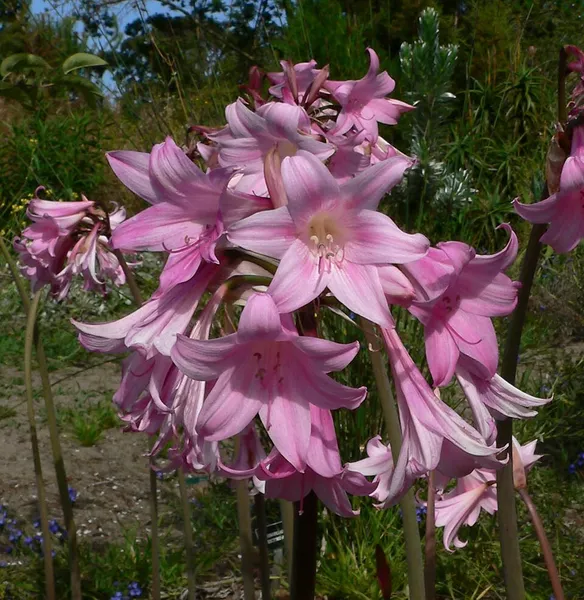
The Amaryllidaceae are a family of herbaceous, mainly perennial and bulbous (rarely rhizomatous) flowering plants in the monocot order Asparagales. The family takes its name from the genus Amaryllis and is commonly known as the amaryllis family. The leaves are usually linear, and the flowers are usually bisexual and symmetrical, arranged in umbels on the stem. The petals and sepals are undifferentiated as tepals, which may be fused at the base into a floral tube. Some also display a corona. Allyl sulfide compounds produce the characteristic odour of the onion subfamily (Allioideae). The family, which was originally created in 1805, now contains about 1600 species, divided into 71 genera, 17 tribes and three subfamilies, the Agapanthoideae (Agapanthus), Allioideae (onions, garlic and chives) and Amaryllidoideae (amaryllis, daffodils, snowdrops). Over time, it has seen much reorganisation and at various times was combined with the related Liliaceae. Since 2009, a very broad view has prevailed based on phylogenetics, and including a number of other former families. The family is found in tropical to subtropical and temperate areas of the world and includes many ornamental garden plants and vegetables.
Also on this shelf
Erigeron pulcherrimus.
Incarvillea.
See also
Uncatalogued shelfText from Wikipedia; plate via Wikimedia Commons. Text CC BY-SA 4.0; plate freely licensed (see Commons). Source record. Images and catalogue data are reproduced from open-access collections.