Botany
Alternation of generations
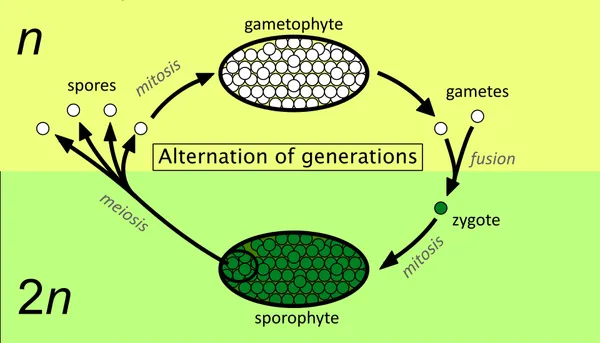
Alternation of generations (also known as metagenesis or heterogenesis) is the predominant type of life cycle in plants and algae. In plants, both phases are multicellular: the haploid sexual phase – the gametophyte – alternates with a diploid asexual phase – the sporophyte. A mature sporophyte produces haploid spores by meiosis, a process which reduces the number of chromosomes to half, from two sets to one. The resulting haploid spores germinate and grow into multicellular haploid gametophytes. At maturity, a gametophyte produces gametes by mitosis, the normal process of cell division in eukaryotes, which maintains the original number of chromosomes. Two haploid gametes (originating from different organisms of the same species or from the same organism) fuse to produce a diploid zygote, which divides repeatedly by mitosis, developing into a multicellular diploid sporophyte. This cycle, from gametophyte to sporophyte (or equally from sporophyte to gametophyte), is the way in which all land plants and most algae undergo sexual reproduction. The relationship between the sporophyte and gametophyte phases varies among different groups of plants. In the majority of algae, the sporophyte and gametophyte are separate independent organisms, which may or may not have a similar appearance. In liverworts, mosses and hornworts, the sporophyte is less well developed than the gametophyte and is largely dependent on it. Although moss and hornwort sporophytes can photosynthesize, they require additional photosynthate from the gametophyte to sustain growth and spore development and depend on it for supply of water, mineral nutrients and nitrogen. By contrast, in all modern vascular plants, the gametophyte is less well developed than the sporophyte, although their Devonian ancestors had gametophytes and sporophytes of approximately equivalent complexity. In ferns, the gametophyte is a small flattened autotrophic prothallus on which the young sporophyte is briefly dependent for its nutrition. In flowering plants, the reduction of the gametophyte is much more extreme; it consists of just a few cells which grow entirely inside the sporophyte. Animals develop differently. They directly produce haploid gametes. No haploid spores capable of dividing are produced, so generally there is no multicellular haploid phase.
Also on this shelf
Carex dolichophylla.
Dichotomanthes.
See also
Uncatalogued shelfText from Wikipedia; plate via Wikimedia Commons. Text CC BY-SA 4.0; plate freely licensed (see Commons). Source record. Images and catalogue data are reproduced from open-access collections.